
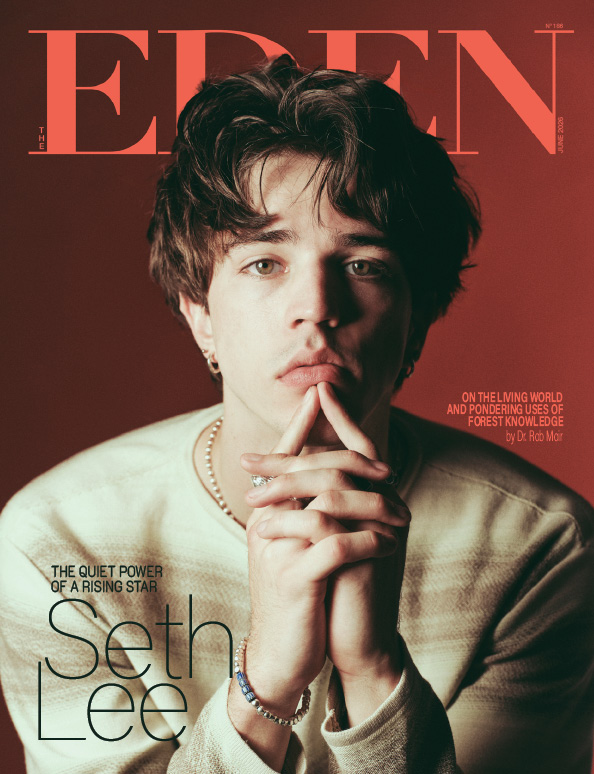
Seth Lee
A New Generation of Hollywood Sophistication
Born in Austin, Texas, Seth Lee moved to Los Angeles at age 11 to pursue his passions for acting and martial arts. A rising talent in Hollywood, he is recognized for his performances in The Accountant and the hit series 1883 and has also made a name for himself in the fashion world through collaborations with luxury brands including CELINE, COACH, and AMIRI.
Beyond the screen and runway, Seth is an accomplished martial artist who began training at just seven years old. His dedication earned him three world titles, along with black belts in Taekwondo and Cinematic Martial Arts (CMA), showcasing the discipline and versatility that continue to shape his career.
Read Our Magazine…
In an industry often defined by image, Seth Lee is part of a new generation of artists reshaping the narrative, bringing honesty, vulnerability, and depth to spaces that have long overlooked them. Discovered by Hedi Slimane and introduced to the world as the face of Celine’s Boy Doll campaign, Seth quickly became a presence in global fashion. Yet behind the polished exterior, he was navigating a far more complex and personal journey.
At just 21, Seth was diagnosed with Type 1 Diabetes after a series of overlooked warning signs. An experience that revealed not only the fragility of health, but also the silence that often surrounds men’s wellness. Today, he uses his voice to challenge those norms, opening conversations around identity, masculinity, and what it means to truly listen to one’s body.
Beyond fashion, Seth is a multi-hyphenate artist. As the lead singer and guitarist of LEED, his upcoming EP It’s All A Blur is a deeply personal body of work that traces moments of unraveling, reflection, and quiet resilience. From the haunting vulnerability of Priceless to the introspective pull of Stain, his music captures the universal experience of being seen yet not fully understood. At the same time, his work on screen continues to evolve, including his role in CreepyAF alongside Sharlize True.
Grounded by practices like journaling, training, and the discipline of Silat, Seth is redefining his relationship with movement, presence, and self-awareness. His journey is not just one of artistic exploration but of reclaiming the body as a place of strength, intuition, and truth.
In this conversation, Seth Lee opens up about navigating illness in the public eye, the emotional landscape behind his music, and the ongoing process of becoming, on his own terms.
You’ve spoken openly about how your Type 1 Diabetes went undiagnosed despite clear warning signs. What did that experience teach you about trusting your own instincts and advocating for your health?
I’ve learned a lot from that time and since. For starters, prior to my diagnosis, I never really went to the doctors as often as I should. I hadn’t really been doing the yearly check-ups, and that alone would have saved me a lot of time and kept me from ending up in the emergency room the way I did. Learning not to be afraid of the doctors and understanding that they are there to save you from any dire consequences was a huge lesson. So I encourage anyone who has a similar fear to get to the doctor when you can, and remember that your health is always the priority.
Advocating for your own health and speaking out about your personal experiences is not only healing for you but can also raise awareness among others who might be struggling with the same situation. I’m not sure if my story has directly influenced anyone to get screened for T1D, but knowing there’s even a chance is enough for me to keep talking about the signs and what to look for. Your body will send you warning signs for a reason, and it’s important not to take them lightly.
The modeling industry often celebrates appearance while overlooking well-being. How did that environment shape your relationship with your body before and after your diagnosis?
I’ll be honest, I went through a phase prior to modeling where my relationship with my body was not the greatest. I struggled with this for a while in my late teens, and what held me back from getting better was not talking to anyone about it. Maybe a few months before I started modeling, when I was 18 or so, a friend reached out and began voicing her concerns about me. It really opened my journey to recovery and set me on the right path. Just sharing with her what I was feeling and going through made me realize how bad it had gotten. So, by the time I started getting into that world, I worked on myself so much that I didn’t face any of those challenges. That would last for a while, until I came out of the hospital. I had never put on so much weight in such a short period of time, and it opened up those thoughts I once had. There were never any direct comments about my weight at the time, but I felt a lack of work coming my way, and there was an obvious reason. It set me back temporarily, but once I started feeling healthy again, my mental strength and clarity set me right back. The stark difference in how terrible I felt when I was the “beauty standard” for modeling, compared to how strong I felt post recovery, made me realize it was never worth the sacrifice.
Conversations around wellness don’t always make space for men. What changes would you like to see in how we approach men’s health, both physically and emotionally?
There’s been a meaningful shift recently. More conversations are finally making room for men’s health, mental wellness, and emotional well-being. But I’ve also noticed the pendulum swinging in ways that feel divisive. Content that uplifts men by undermining women or frames it as one group’s gain versus another’s loss. That’s not the kind of progress I want to be part of.
What I’d love to see? Equal space, equal nuance, equal compassion for everyone.
Your song “Priceless” came from a deeply vulnerable time in your life. When you listen to it now, what emotions or memories come back to you?
I think the first thing that comes to mind when I listen back is how proud I am of how far I’ve come. You can say there’s a layer to this song that is essentially me writing to my younger self, in the heat of all that chaos, and telling him, “It’s all going to be okay. You will only come out of this stronger than ever.”
The only pain that might still resonate when I look back is that feeling of emptiness coming out of it and fearing what the response might be. Wondering if the industry would accept me now that I’m facing these other challenges. I used to think, “Why would anyone want to deal with the possible strains of working with me when my diabetes might be a potential setback on set”? For a moment, it was very isolating for me. I’ve been working almost my whole life to get where I want to be in my career, and now I have to worry that this might ruin all the work I’ve put in. It sent me down a spiral.
Each track on It’s All A Blur seems to explore a different emotional landscape. Was there one song that was the hardest, or most healing, for you to create?
That’s a tricky one. Many of these songs came from a place of desperation, a desire to share something about me or my experiences. So, there have been many healing moments in the writing process. I would say Yellow Birdie was possibly the most healing, because I started writing that song towards the end of my last relationship, before we broke up. It helped me navigate the words I wanted to say to her before I said them. Living in that grey area in a relationship where both parties know it’s coming to an end, but no one has quite had the time to find the words or figure out how to end it, is exhausting. So being able to put it on paper and in song gave me the opportunity to deal with those very active emotions.
You’re balancing music, acting, and a modeling career. How do you stay creatively grounded while navigating such different industries?
What’s so great about balancing all these creative outlets is that there’s typically a chunk of time between projects. With modeling, fashion week happens every few months. In film, it takes time to find the right follow-up project. So, I usually focus on one thing at a time. There are times when the overlapping happens, and that’s always a wild experience, but I honestly enjoy the rush. I think in those moments, I return to my notebook and journal as much as I can. When navigating all these different modes of expression, you can get a weird case of imposter syndrome. Switching hats makes you forget that you’re accessing the same voice and unique individual experience. So, when I’m journaling, I’m able to ground and center myself back into my artistic voice.
In your upcoming film CreepyAF, what drew you to the project, and how does this role differ from what audiences have seen from you before?
To answer both your questions a little bit. I was drawn to this project at first because of the boundaries it pushed me to push. It’s a physically demanding role, requiring you to communicate almost all of Malcolm’s story through body language alone. He’s a man of few words, but he’s dealing with so much internal conflict. I hadn’t been given a script that asked this of me before, so my first fear was immediately overacting it. I wanted to share all of Malcolm’s complicated feelings with the audience, but I couldn’t play it up for the camera. So, I worked overtime to make sure I nailed his mannerisms with ease and that it all felt natural. I would practice in my apartment all the impulses I had, how he moves, how he breathes, etc. Then put it on tape to see how it reads on camera. I would make adjustments as needed, so that by the time I showed up to shoot, I understood what felt real for Malcolm and what felt like I was pushing.
You’ve taken up Silat to reconnect with your body. What has that practice taught you, not just physically, but mentally and emotionally?
Silat has been a very fascinating martial art to study. There’s a foundation of spiritual practice that I’ve been a huge fan of. Through that, I always come out of my sessions feeling very connected to the ground below me, and it allows me to leave my ego and stress behind. It has reminded me of the value of the present and how to achieve that in another practice. In a physical sense, I love the fluidity in the combat style. It’s taught me the relationship between rhythm and movement in a new light.
What is a small, random moment from your life that somehow made its way into one of the songs?
You know, I’m not sure there’s a random moment from my life that’s on any of the songs, but I can give you one of my favorite easter eggs on the EP. Last Christmas, I got my nephew a kid’s guitar, and at the time, I was just starting to work on the songs, but I knew I HAD to have him play a note and put it on the project somewhere. The guitar refuses to stay in tune, so we had to manipulate it heavily to make it work. It’s a very quick moment on the track “Lucky”, but I’m so happy we got it to happen. I like to include these little moments in some of my work for me, or for my family and friends.
When you’re not creating or training, what’s something simple that brings you peace or joy these days?
There are quite a few things. Most importantly, being in my early 20s means you have to make a greater effort to see friends and family. Often in your early adult life, people get into their routines and chaotic schedules, especially since most of my friends are creatives. One minute they’re in town, and the next they’re off somewhere else. Even just calling them to ask about their day or what I might have missed recently has brought a lot of joy, and when we are all able to see each other, I cherish every second.
In my own time, I find a lot of happiness exploring around my city. Specifically, going out to try new coffee shops, maybe hitting up one of my favorite record stores, Super vinyl, and going to the endless options of flea markets here in LA. With summer approaching, I’ll find myself surfing, which is like the best way I could start my day. Then, when winter rolls around, getting back on the mountains for some snowboarding is the closest thing to heaven on Earth for me.
Outside of music and acting, what’s something about you that people would be surprised to learn?
Hmm. I think one thing I don’t talk about too much these days is the time I’ve spent behind the camera. When I was 14, I attended Ghetto Film School in Los Angeles and spent the following 3 years studying filmmaking. Once I graduated, I got into directing short films and music videos, gaining experience in camera operation and screenwriting. One of the highlights of that side of my career was seeing one of my shorts screened at the Huntington Library, a museum located in Pasadena. It’s been a minute since I’ve gotten back behind the camera, but I still hope to direct a feature at some point in my life. I’ve been sitting on two feature scripts for a minute, and I’m still crossing my fingers that they’ll get produced.
Special Thanks to:
Seth Lee
Photographer: Jonny Marlow
www.jonnymarlow.com
Editing: Dina Morrone

Comments