
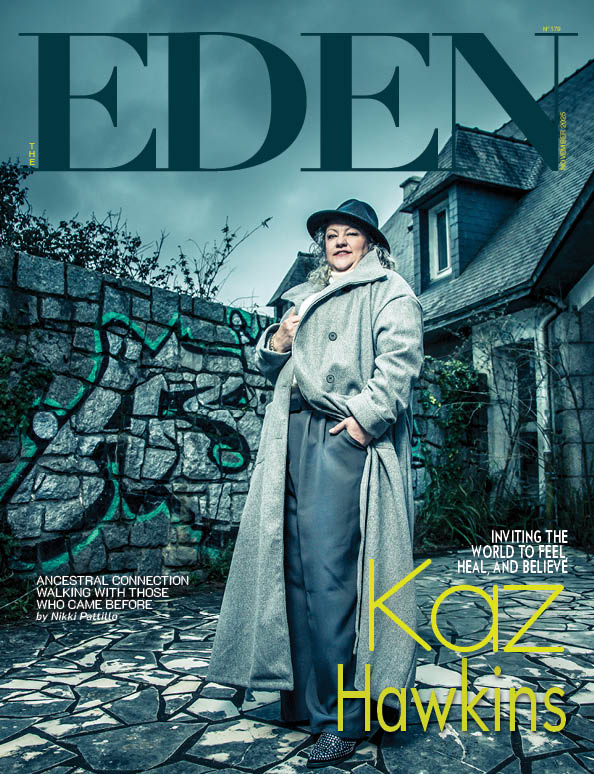
Kaz Hawkins
A Voice Carved from Heart and Harmony
The extraordinary Kaz Hawkins, a voice as powerful as it is tender, and a spirit whose resilience continues to inspire audiences across the world. With her soulful storytelling and boundless authenticity, Kaz has transformed her journey of challenges and triumphs into music that heals, uplifts, and connects deeply with those who listen. Her artistry is not just about melody and words, but about courage, honesty, and the reminder that through vulnerability comes strength.
We are delighted to share her story with you, one that shines with warmth, passion, and hope.
Read Our Magazine…
Your music spans blues, soul, jazz, and Celtic influences—how do you intuitively know which genre a song belongs to when you’re writing it?
I’ve never sat down and thought, “I’m writing a blues or a ballad song today.” The song tells me where it wants to go. Sometimes it’s got that blues grit on guitar, or sometimes I sit at the piano & let my fingers lead the way, feeling what I feel in the moment. It’s mostly my pain or joy that directs me, not a genre. My job? To feel my way and dress it in the right “musical clothes.” As artists, we are often limited by society’s expectations to fit into a single category, allowing marketing to dictate where we are positioned. My Celtic influences don’t come naturally, as I never experienced Traditional Irish music, but I play a little Bodhrán Drum, and it is now having an effect on the songs I am releasing now. They say there is a Celtic rhythm in all of us born on the island of Ireland.
In 2025, you are launching several distinct musical projects. What inspired you to separate your work into these focused formats, and how do they reflect the different facets of your artistic identity?
For years, I threw everything together like one big stew, which some people found confusing. But since living in France and now as I’m embarking on a year-long European Tour, I thought, no! Let’s let each side breathe and have its own identity. I’m fortunate enough to have a growing fan base that I am very open with, allowing me to see what suits different fans.
The blues/rock quintet? That’s fire and grit and my longest-running show. It’s all about being a diva; they call me ‘Mama Kaz,’ so I open these shows and festivals with a big growl, singing ‘Come to Mama.’ This appeals to the blues/rock fans because they get to dance. I don’t do many of my ballad hits in this show, but when I perform Because You Love Me with my guitarist’s epic solo, people are transported to a time when they used this song for their own healing.
The piano/voice duo? That’s me stripped right back, and the show is called My Life And I, which tells the story of each song I wrote. It is my mental health mission to create a safe space for the audience to let any feelings they want out. These are my hit songs that have helped build my fan base. My ballads have helped so many in times of need. For me, it’s also cathartic as I share my most personal memories in the hope it gives someone else the strength to fight. As a mental health mission, it’s also to educate and inform those who may not understand what someone is going through. This is my safe space to talk about social issues like domestic violence, abuse, and more.
The Jazz/Celtic Quartet? That’s elegance and storytelling. I don’t come from a jazz background, but it is a free form that allows me to go where I want at that moment. Adding a Cello in this format has brought in a beautiful Celtic feel, which means I can take my songs to another creative place.
All of these projects are like showing the world all my personalities. I have ADHD, so this also helps my brain put everything in the right place. Although my tagline now is ‘It’s not blues, it’s not jazz, it’s just Kaz’ haha.
Your recent songs include sweeping orchestral arrangements—what drew you to this cinematic style, and how has it expanded your storytelling through music?
I’ve always dreamed or imagined things in widescreen. Working with an orchestra let me paint on the biggest canvas possible. When those strings swell, they take my story higher than my voice ever could on its own. It’s not just music; it’s an emotional connection like no other.
Dramatic, all-consuming, and glorious yet calming and rhythmic. My new album will also release some Orchestral Versions, so this will be new for the fans.
Your documentary, My Life and You, is a deeply personal portrait. What was it like to revisit your past while filming, and what do you hope audiences take away from your story?
It was like opening boxes in the attic you swore you’d never open. Painful. But necessary. I had to sit with parts of my story that I’d buried deep. I have always been very open and vocal about my story, but this was different because I had always had control over how I told it. This was a production team presenting my life. Everyone was incredibly supportive and gave me the space I needed when I needed it. Still, it was emotionally exhausting, so much so that I collapsed to the floor when we filmed the last shot, which was my most personal song, Surviving, about losing my childhood to a family member.
I disappeared into my head for 3 days after it because it drained every inch of strength from me, and I needed to fight and remind myself what it was for, to help others. Then I saw just how far I’ve come. I’m still in awe of myself, even now, for doing that, so I want people to watch it and think, “If she made it through… maybe I can too.” This is the only legacy I want for my music.
Survival and resilience are recurring themes in your work. Can you share a moment in your journey where music became a lifeline for you?
After I left an abusive relationship, I was empty, addicted to Cocaine, and broken. As you will hear many survivors say, I went with nothing and had to rebuild. Writing One More Fight gave me a reason to get out of bed. It was my scream into the void, and then that scream became my lifeline. The song is a thank you to the policeman who saved me, the doctor who healed me, and my mother who came back from the grave when I lay dying on the ground to tell me, ‘get up, one more fight, darling, one more fight’—hallucination, perhaps, but it made me fight.
Life is always one more fight, some fights more traumatic, but even the simple things, like trying to get through the day without thinking you’re a failure, is a fight. What is more important is celebrating the positives, and for me, it was the people who saved my life; however, this can mean something different to others. This is resilience, keeping going and knowing you are worth the fight. I used to say, ‘I can’t fight anymore, I don’t have the strength,’ but now I realize this is negative in itself. I have my own way to deal with my demons, so now I drown out the noise with positivity, peace, and lots of love.
You were invited to the Florence Academy of Art in Alabama to participate in Something in the Water, an initiative designed to raise awareness about the limited access to the arts for children in Alabama. What did that experience mean to you personally and artistically?
I saw kids who’d never had access to the arts being given that chance. Their faces and their talent were so amazing. I’ll never forget them. That spark, that light. It reminded me that art isn’t a luxury. It’s survival for some kids. As I came from an impoverished background, I could identify with them, and I was shocked that, in these modern times, something as simple as music should be accessible to any child. I now live in France, and giving children access to music is deeply ingrained in the fabric of education and culture here. In Alabama, some of the world’s greatest artists have produced music, so it meant so much more knowing this hardship. For example, Muscle Shoals was once the ‘hit recording capital of the world’ and yet these children didn’t have access to only the stories of times gone by.
Jerry Foster, the principal of the school, is trying everything he can to help these children, so I sang some of those hits for the record, Something in the Water, to help them raise money.
As someone who has overcome profound personal challenges, how do you protect your energy and stay grounded while continuously sharing so much of yourself on stage?
I pour every last drop of myself into a show. I give the audience all I can, so off stage, I have to rejuvenate again. I take time out at home, and I turn the music off for Silence. I meditate, sleep, and reboot my confidence by focusing on myself. I’m still learning that the word “no” isn’t selfish; it’s a matter of survival. I moved to France so that I wouldn’t have memories on every street corner holding me back. I’m thankful to my talent for that opportunity, because many people cannot simply up and move. For me, I had to leave Northern Ireland, as the triggers were everywhere. I return home every few years for a show, as I will never forget my roots; however, my life is now in France. I have a great record label, Dixiefrog, which has supported me since 2020. With a strong support network of friends, I can stay resilient and continue my music mission, which I began in 2010, focused on mental health.
You’ve become a powerful voice for mental health awareness and domestic abuse survivors. How do you balance being a performer with the emotional responsibility of advocacy?
The balance is remembering my role. I’m not a therapist. I’m a light-holder. I carry the flame until someone else can carry their own. The music is a safe space where the audience can feel free to cry, laugh, or just be silent and listen. I sometimes cry during certain songs (especially when I’m very tired), and I can hear the gasps and cries from the audience. However, after, I remind them that it’s okay to cry, to release what is inside, but that we cannot stay there. I then play a fun song that makes everyone laugh, because I’m a joker too, and it’s a roller coaster of emotions that they can experience within the security of music. This lets them know that I, too, am normal, and in this moment, together we are one, carrying each other. Therefore, the burden they carry isn’t as heavy for a few hours. That is the greatest gift I can give through music, time out from the pain.
What changes would you most like to see in how the music industry supports artists dealing with mental health issues or trauma?
I’d love to see mental health treated the same as physical health. No shame. No “push through or you’ll lose the gig.” Just proper support, flexibility, and understanding that cancelling for your mind is as valid as cancelling for a broken leg. Additionally, this industry is one of the most challenging to navigate because it is constantly evolving and rejecting new ideas. For years, I was a secret songwriter because I was afraid of rejection, and it wasn’t until my 50s that I became completely comfortable with my talent and contribution to the industry. I don’t want other musicians to have to wait so long for this security. Every gig is someone else’s business to make money, so there needs to be a mindfulness of everyone’s contribution.
Can you tell us about a moment when someone from your audience told you your music or advocacy made a difference in their life?
I receive daily tags and messages across social media with stories, and because I’m very accessible to my fans, I get to know many of them. Some have even become close friends. A young woman once made a 15-hour return trip to see me after hearing One More Fight. She was fighting addiction. My song gave her the courage to change her life. A few weeks later, she saw I was playing in Muscle Shoals, and she had to be there. I was singing for friends in a little juke joint, and she arrived. I knew she was a singer & I saw her at the back of the room crying into her hands, not believing she was there. When I began to sing the song, I called her up on stage to sing this song with me. I cradled her in my arms as she cried, trying to sing, but in those few moments, she knew she was safe. She didn’t need to sing the whole song; the little bits she could muster were enough between her tears for her to know she was safe. I knew what she was going through. I held her tight and kept singing as she wept and expelled whatever demons were holding her to ransom.
It was something I can’t explain to anyone, only that the music kept us safe. I have watched her grow and while she still battles, she aims every day to have a career in music. Telling my story doesn’t allow me to fix people; I hold them in whatever way I can to remind them of their own strength and that they are worth it. Then they return to the world rejuvenated.
What message would you like to share with those currently living in fear due to domestic or sexual abuse?
These things are none of your doing; they are not your fault! Secretly tell yourself that one day you will be free, that you deserve to be happy. My life was for so long in guilt for something I had no control over. I know it’s frightening! I know bravery seems like something for superheroes, but you are brave every day, right now, navigating what is happening to you and still fighting! I am with you and using my voice for change. Please know that you deserve the chance to love yourself unconditionally and that you are not defined by these deeds EVER! I promise you, as a survivor, life can be beautiful. The scars I still carry are my badges of honour!
You said your tattoos are your armor and a way to give hope. Can you tell us about the first piece you chose and what it meant to you at that moment?
My very first tattoo was a little cupid shooting his bow. I was in my twenties, young and romantic, and I thought it was sweet. At the time, it was just that: a cute little mark. It only became armour later on. As the years passed, I began to cover scars from self-harm with art, turning pieces of pain into something beautiful and intentional. Now, Cupid has been replaced by a design inspired by my Aquarius water sign, a reminder to stay calm in the storm. I’m not ashamed to say those scars are still there under the ink; that truth is part of my story. But choosing to look at my skin with creative eyes instead of shame has been its own kind of healing. My tattoos are a language I use to say: you can turn a negative into a positive, you can reclaim your body, and there is hope on the other side.
How has sharing this part of your story changed the way fans or strangers connect with your music and your message?
When I began opening up about my story, I didn’t realize how deeply it would resonate. Now, there’s this intimate bond between me and the audience. People don’t just come to hear songs; they come to feel less alone. They often share their own traumas with me, and because my shows have become a safe space, there’s a sense of healing in the room. It’s not just performance anymore, it’s connection, it’s community, and it reminds us all that music can hold the weight of things words sometimes can’t.
Having moved from Ireland to France, how has living abroad influenced your creativity and perspective as both an artist and a woman?
Wow, it has changed so much. France is a melting pot of different cultures, with many African/Ethiopian influences in parts of the country. However, in other parts, it still very much honours its Medieval roots. It’s not strange to see someone sitting with an accordion or instruments even older than the chateaus themselves, which is a wonderful thing to experience as a creator. Culture in general is appreciated and supported more. The audience somehow knows exactly all you put into a song to bring it to life; they celebrate it with you, vocally, stamping their feet, maybe even dancing. I am always overwhelmed by their willingness to let themselves be free in the moment. This has given me peace I never had before. To create without expectation and not according to any rulebook.
You’re now exploring Celtic Contemporary sounds—what does reconnecting with your Irish roots mean to you at this stage in your career?
I’ve never performed Irish Traditional music, even though I’m from Ireland, so it’s not really going back to my roots, but rather I wanted to explore my heritage. I’m of Scotch-Irish and Norwegian ancestry, so I feel a very rhythmic essence in all my music. Celtic vibrations are felt throughout most societies today, so I’m blending it now with the woman I’ve become. I love to play percussion as it’s like expelling my demons when they raise their heads from time to time.
Any upcoming projects?
Yes, I’m so excited to be releasing my latest album, Coming Home, in Dubai on November 15. I no longer suffer trauma, but I am a singer/songwriter, so I have many stories yet untold. This album is about coming home to myself, no genres, no expectations, and only for me. I have felt imprisoned most of my life, and this album is the creation I have dreamt of for so long. For the first time, I collaborated with my songwriting friends Mathis Richter-Reichhelm and Michael Handshuh in Berlin, where I recorded this album. I had songs that I buried nearly 30 years ago, and they helped me revive them. I will then tour the album with all my projects on a huge year-long European Tour. I will also release my second live album in 2026, so I’m setting myself up for the biggest year of my life. But at 52, I say, “It’s not blues, it’s not Jazz, it’s just Kaz, so why not?” The challenge is to navigate all this during the throes of menopause, which is another interview in itself, but for now, I thank your readers for this opportunity to share a little of my life with them.
Special Thanks to:
Kaz Hawkins Socials/Youtube
@kazhawkinsmusic
www.kazhawkins.com
Photography by Philip Ducap
MUA/Wardrobe Emilie Gomez
Editing by Dina Morrone
Location in Brittany, France with

Comments