
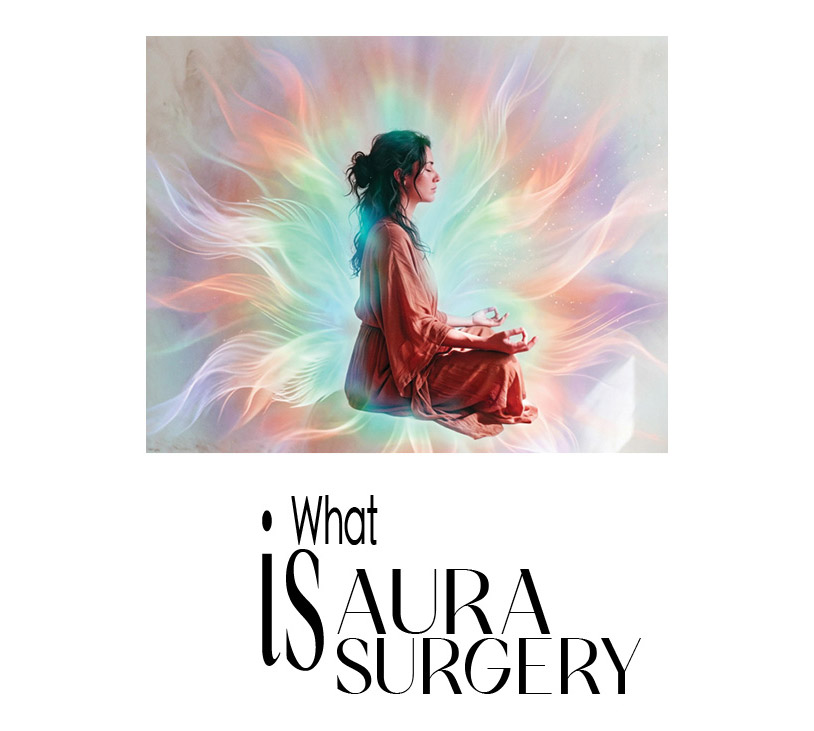
What if the root of chronic illness, recurring emotional patterns, and even self-sabotage isn’t just physical—but energetic? In Aura Surgery: Healing Karmic Patterns and Unconscious Conflicts in the Juman Energy Field, neurologist Dr. Mathias Kunlen and Christine Waldhause-Kunlen present a groundbreaking perspective on healing that blends science, consciousness, and subtle energy work.
Drawing on 30 compelling case studies, Aura Surgery is a non-invasive method that works with the body’s energy field to identify and release inherited trauma, unconscious beliefs, ancestral wounds, and Karmic imprints, which are believed to manifest as emotional and physical illness. Through this innovative approach, Dr. Kunlen explores conditions ranging from panic attacks and diabetes to serious diseases, offering a new understanding of how unresolved energetic patterns may influence human health.
Aura surgery is surgery—quite literally. The term refers to non-contact operations on the subtle body.
What does that mean?
“Non-contact” means that the interventions performed by the aura surgeon occur “extracorporeally”; that is, without touching the somatic body of the patient and working exclusively in their aura, or subtle material body.
As the term suggests, “subtle material” refers to materiality, but in such a low density that this state is not visible to the human eye. Every organism is permeated by subtle materiality, but it is also surrounded by it externally.
Subtle materiality is the transitional phase between energy that is invisible to us and coarse material matter, which we can perceive with the naked eye. Physically speaking, energy and matter are equivalent, as expressed by Albert Einstein in the formula e = mc² (energy is equal to mass times the speed of light squared). This means that energy can be converted into matter and, vice versa, matter into energy.
It is precisely at this transition point that aura surgery takes effect. The therapist sets impulses at the spiritual level that lead to changes: first in the subtle body, and finally in the coarse material body of the patient.
For example, cysts or gallstones frequently regress in their corporeal form after aura surgery—with a time delay of weeks to months—and consequently no longer appear in imaging techniques, such as ultrasound, X-ray, or magnetic resonance imaging. In this respect, these are genuine dematerializations. Conversely, using aura surgery procedures, physical structures can also be newly formed as materializations.
The operating principle of aura surgery follows this sequence:
Information—Subtle Materiality—Coarse Materiality
What Does My Aura Surgery Setting Look Like?
My patients frequently arrive with a long history of suffering. They are often considered to have “no further treatment options”—a gentle phrase for a hard reality, one might say, meaning nothing other than that conventional medicine has given up.
At the beginning of the session, I inquire about the reason for their visit as well as their complaints. However, I do not perform a full anamnesis, which takes into account the patient’s entire medical history. A description of their symptoms alone is enough for me to develop an idea of where to look from an energetic-informational perspective.
This is because the specific disease of an organ is not decisive. The very fact that it is diseased is what provides me with insights into the biological purpose and the informational causes behind it.
How Do I Arrive at a Diagnosis?
The key to the diagnosis is resonance! What is “resonance,” and how does it arise? Resonance (from Latin resonare, to resound) describes the fact that when the therapist reaches into the patient’s aura the patient feels it physically.
Resonance can even be triggered at a distance of up to several meters when the therapist uses certain hand techniques to reach into the patient’s subtle body. Another way to trigger resonance is for the therapist to apply pressure with tweezers to the image of an organ or a plastic organ model (called a “surrogate”) or to poke it with a surgical probe.
A true paradox: This resonance phenomenon occurs even when the patient has their eyes closed or when the therapist is working behind them. The principle of resonance is reproducible and indicates that the corresponding organs are energetically disturbed and in a suitable state to receive treatment using aura surgery.
Resonances tend to be mild. The patient feels a slight pulling, stabbing, pressing, or tingling feeling in the part of the body being examined. In rare cases, however, this sensation can be intense. I have had patients who cry out and even jump out of the chair when I insert a surgical probe into the intervertebral space of a plastic model of a spine, for example, and hit the exact point at which they are experiencing symptoms related to their herniated disc. Resonance is the central element of aura surgery!
It either occurs or it does not, following a binary principle.
Resonance directly correlates with the clinical symptoms: The more pronounced the symptoms, the more intense the resonance. At the same time, it corresponds to the location of the symptoms. This makes it an infallible diagnostic tool. I can pinpoint exactly where the energetic disturbance is located in the organ, enabling me to perform the aura surgery right at that point.
The decisive factor is not the morphological modification but the energetic disturbance. In practice, I often find that morphological diagnostics, such as those provided by X-rays, do not necessarily align with the energetic findings or with the symptoms described by the patients. I repeatedly observe discrepancies between morphological and clinical findings, both in location and intensity.
Example: The radiological examination of the spine shows a herniated disc between the fourth and fifth lumbar vertebrae, whereas the patient describes symptoms that do not show up as corresponding morphological modifications on the X-ray. Instead, their complaints and my examination results indicate a disturbance one segment above or below.
Also, the severity of the morphological change does not necessarily correlate with the extent of the symptoms or the energetic disturbance. This means that the radiological examination can show a massive arthritic change in the patients’ joints, yet they move with no pain at all.
Conversely, some suffer from extreme pain, even though the radiological findings are unremarkable. It is quite obvious that the mind determines the intensity of the individually perceived symptoms.
Experience shows that symptoms and resonance correlate much more closely than symptoms and morphology. If a person is suffering from symptoms in a specific body area, it can be assumed that, when tested for resonance, there will be a corresponding positive result, meaning that they will feel a slight pulling, stabbing, pressing, or tingling sensation.
On the other hand, if there are no symptoms associated with an organ, even though it is morphologically significantly changed, the likelihood is high that no resonance will be triggered there. This insight has significant consequences for therapy. Aura surgery is performed according to the resonance principle, not morphological change. Consequently, this means that the expected therapeutic success is greater.
From the perspective of a mind searching for logical proof, a healing method like aura surgery may seem strange, possibly even implausible. However, it is not necessary for proof of its effectiveness to be provided through materially measurable chains of evidence.
Mathias Künlen, M.D., is a doctor of neurology and founder of the institute for Aura Surgery (IFA Institut für Aurachirurgie) in Liechtenstein. He is also the founder of Softmark AG Grünwald, which develops software in cognitive computing andbio-programming. He practices near Munich, Germany. Christine Waldhauser-Künlen is a journalist with a background in political science. She has been researching nutrition and holistic medicine for more than 30 years.
Aura Surgery by Mathias Künlen, M.D., and Christine Waldhauser-Künlen, published by Inner Traditions International and Bear & Company, © 2026. All rights reserved. www.Innertraditions.com
by Mathias Künlen, M.D