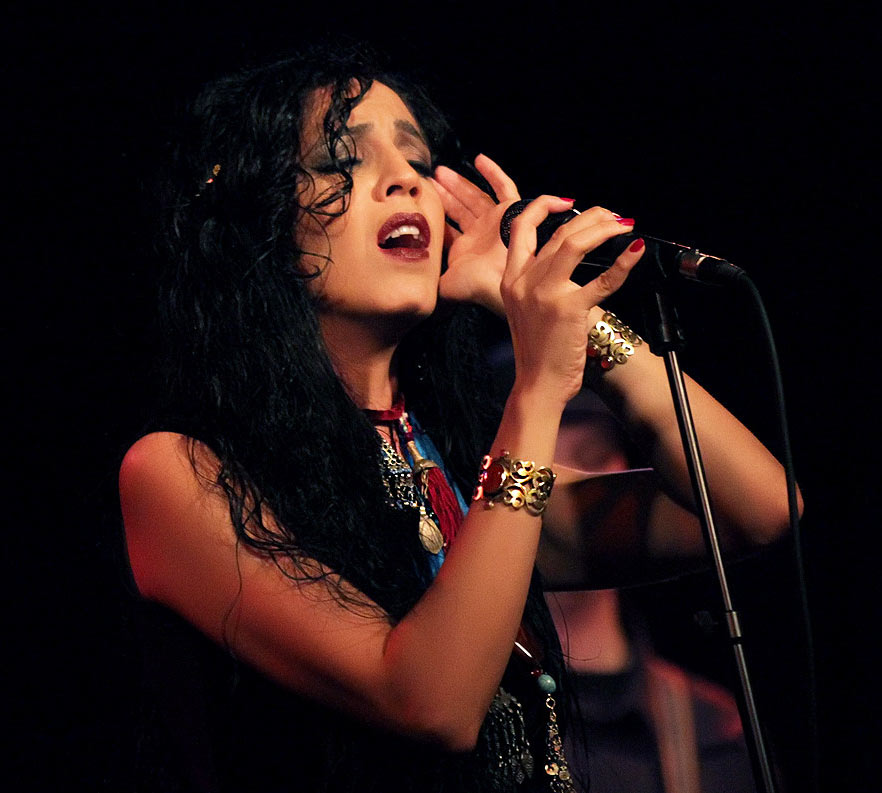
Few artists possess the ability to transport listeners beyond time and place quite like Azam Ali. With a voice that seems to echo from the depths of ancient memory, Azam weaves together the threads of culture, emotion, and spirit into an otherworldly musical tapestry. As a singer, composer, and visionary, her work bridges the mystical and the modern, inviting us to explore the shared soul of humanity through sound.
From the ethereal soundscapes of Portals of Grace to the haunting depth of Elysium for the Brave, Azam has continually redefined the boundaries of world and electronic music. Each project reveals a new layer of the artistic evolution, rich in emotion, steeped in
spirituality, and fearless in experimentation.
Her latest album, Synesthesia, marks yet another powerful transformation. Unlike her earlier works that embraced ancient melodies and meditative tones, Synesthesia immerses listeners in a vibrant fusion of sound and color, where motion takes on texture and rhythm becomes a language of its own. It is an experience that transcends listening, an invitation to feel music with every sense.
In this exclusive interview with The Eden Magazine, Azam opens up about her creative journey, the inspiration behind her hauntingly beautiful music, and the power of art to heal and unite a divided world.
Azam, your music transcends borders and languages, blending ancient mysticism with modern soundscapes. How did your early life in Iran and India shape the artist you are today?
I was deeply shaped by the cultures of both Iran and India. Their ancient mysticism, folk traditions, and poetry became the foundation of my inner landscape. When I later moved to America, these influences didn’t remain separate; they wove themselves together, evolving into the fabric of my artistic expression. My music transcends borders and languages because it speaks to something far more elemental than words; it speaks to the soul. Music is the one true universal language, capable of dissolving boundaries and revealing our shared human essence. In that sense, my work is both a reflection and an offering, my autobiography told through sound and emotion.
You’ve explored so many dimensions through your projects — from Vas to Niyaz and your solo work. How do you decide which creative path to follow at a particular moment in your life?
My creative path has never been an intellectual choice; it’s always been a deeply personal exploration. Each project represents a stage in my own evolution, a way to go inward and uncover another layer of truth. Whether with Vas, Niyaz, or my solo work, I follow an inner calling rather than a concept. I create as an act of self-healing, a way to transmute pain into beauty, and in that alchemy, I’ve discovered that others, too, find resonance and healing within my music. My aim is always to refine my craft so I can express with greater clarity and eloquence the ineffable: the mysteries of the human spirit, the longing for connection, and the sacred pulse that runs through all life. For me, music is not a career; it’s a journey toward ever-deeper understanding.
Your voice carries a profound emotional resonance that resonates with the spirit. When you create, do you approach music as a spiritual practice, a form of storytelling, or something in between?
For me, creating music is an intimate convergence of the spiritual, the emotional, and the deeply personal. It is a form of prayer and self-healing, a way to return to truth through sound. Each song is a meditation, a sacred act of transforming emotion into vibration, sorrow into beauty, silence into meaning, and vulnerability into strength. In that space, I am both storyteller and seeker, revealing what words alone cannot hold. Without that transparency, that willingness to be completely honest and vulnerable, I don’t believe my music would resonate with others. It is through complete surrender that the sacred finds its voice, and where my healing becomes intertwined with the healing of those who listen.
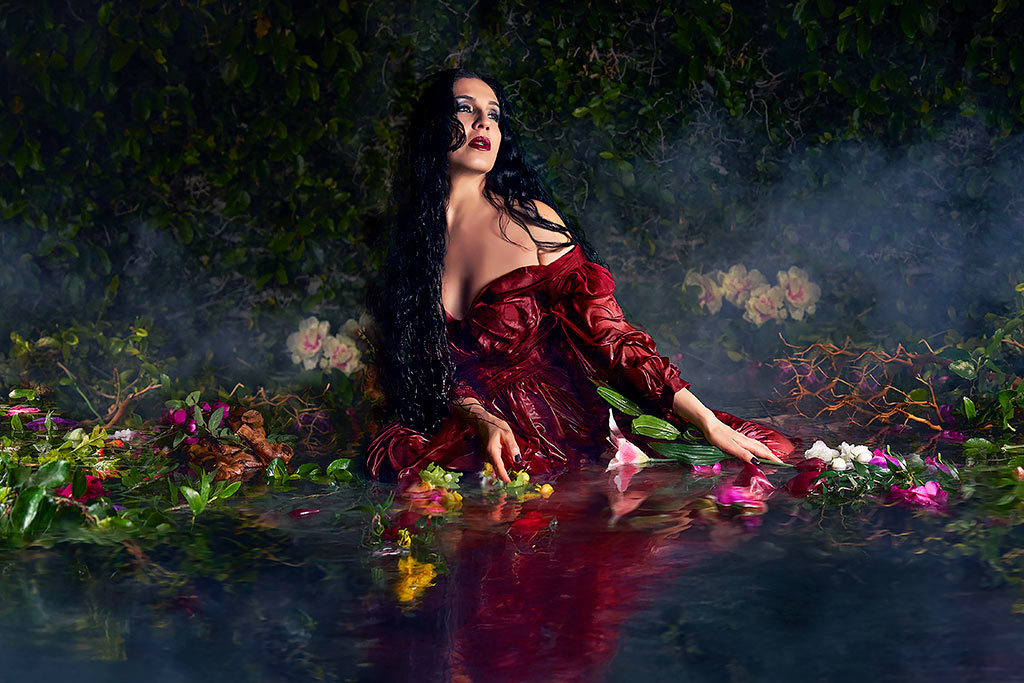
Many of your songs draw from Persian poetry and Sufi philosophy. What draws you most to these ancient writings, and how do you translate their essence for a modern audience?
What draws me most to Persian poetry and Sufi philosophy is their timelessness, their ability to speak to the human condition beyond creed, culture, or era.
These traditions have ancient roots that reach deep into the collective soul, yet they remain vibrantly alive because they transcend all forms of religious dogma. At their heart lies a boundless love, for the Divine, for creation, and for the journey of the soul toward enlightenment and unity. The metaphors of Rumi, Hafez, and Attar are as relevant today as they were centuries ago, because they speak to that eternal longing within us all: the desire to return home to ourselves, to the Beloved that lives within every human heart.
Through this music, I hope to carry the listener into the vastness of the ethereal, a space where freedom breathes and every note reveals our intimate connection to a greater design.
Over the years, you’ve collaborated with incredible musicians across cultures. What has been the most transformative collaboration or moment in your career so far?
I have been deeply honored to collaborate with some of the most astounding composers and musicians, and from each, I have learned, grown, and expanded my own artistic vision. Yet, if I were to name a moment that stands above all others, it would be a few years ago when I had the profound privilege of performing two works by one of Iran’s greatest composers, Ahmad Pejman, with the Pacific Symphony Orchestra. To sing his music in his presence and witness the joy it brought him was an experience that moved me at the deepest level. It was a moment of profound connection between composer, performer, and music that I will carry with me always. This memory is made all the more poignant by his passing this year, leaving behind one of the most extraordinary legacies in Iranian contemporary classical music. That encounter, that shared celebration of art, remains for me a pinnacle in a lifelong journey of musical discovery.
You performed “Persia After Hours” at the Getty Villa on May 14, 2022, which was the first-ever concert at the venue. Tell us how this collaboration shaped?
Performing Persia After Hours at the Getty Villa remains one of my most cherished memories on stage. The concert, presented in collaboration with Farhang Foundation, with whom I have had the honor of working many times over the years, felt like stepping into a living fairy tale. That night, under a full moon that rose perfectly center stage, the projections of ancient Persia came alive around us, enveloping the audience in a tapestry of history, mysticism, and light. The alignment of music, visuals, and celestial timing created a truly magical and transformative experience, one that felt both intimate and timeless, as if the past and present were converging in a single moment of shared wonder.
You’ve spoken before about the healing power of sound. How has music helped you navigate your own personal journey, both as an artist and as a woman?
As a child, I first discovered the healing power of music when I would be swept away by melodies into other worlds, forgetting my body and my surroundings. Music became a sanctuary, a space where I could dissolve into something larger than myself. As a teenager, when I was struggling with deep depression, I began creating music as a way to heal, to navigate the shadows of my own mind and spirit. Over time, I realized that the music I was making wasn’t only helping me; it was touching others, resonating with their own experiences, and offering them solace. That realization transformed my art into a form of service, a bridge between souls. Creating music became both a personal journey of healing and a sacred act of connection, reminding me, and those who listen, that even in our darkest moments, there is light that can be found and shared.
The world continues to face so much division and uncertainty. What role do you believe music and art can play in uniting people and elevating human consciousness today?
Throughout history, music and art have been inseparable from the great social and political transformations of humanity. They awaken conscience, ignite empathy, and remind us of our shared essence when words and ideologies divide us. Artists, in their truth-telling, carry a sacred responsibility: to give voice to those who have been silenced, to translate collective pain into beauty, and to champion human rights and dignity for all.
Music, in particular, is both a balm and a beacon, a conduit for healing and a rallying cry for unity. It moves through barriers that language cannot cross, touching what is most primal and divine within us. In a time of such fragmentation and uncertainty, the role of the artist is more vital than ever: to keep the flame of empathy alive, to defend the rights of the oppressed, and to remind the world that despite our many differences, we are all part of one great, pulsing rhythm of existence.
Can you share with us a glimpse into your upcoming album — the inspiration behind it, and what listeners can expect emotionally and sonically?
My album, Synesthesia, is conceived as an invitation, an entry point into a world beyond the ordinary confines of time, place, and the fragile vessel of flesh. Through this music, I hope to carry the listener into the vastness of the ethereal, a space where freedom breathes and every note reveals our intimate connection to a greater design. It is a journey of transcendence: we are no longer solitary beings, but shining stars drawn together into galaxies, each tone a reminder that we are participants in a cosmic symphony far larger than ourselves. It is music that seeks to dissolve the barriers between the listener and the sound, between the self and the cosmos, leaving behind only wonder, resonance, and a profound sense of belonging.
What message or feeling do you hope your listeners carry with them after experiencing your music?
Ultimately, I hope my music reminds listeners that we are far more than mere beings of flesh and bone; we are intrinsically part of the cosmos itself, composed of stardust and intimately woven together into the vast rhythms of existence. Music, perhaps more than any other art form, has the power to evoke this awareness because it is so intangible, so esoteric, and so closely aligned with the subtle harmonies of the universe.
There is an ancient philosophical concept, originating with the Pythagoreans, called Musica Universalis, or the “music of the spheres.” It proposes that the movements of planets and stars follow mathematical principles that produce harmonies too subtle, too constant, to be perceived by the human ear, a kind of higher order of music that governs the cosmos itself. I have always been fascinated by this philosophy, so my hope is that through listening, people feel a glimpse of this cosmic resonance within themselves; that they recognize their part in a greater, boundless symphony, and carry with them a renewed sense of wonder, connection, and unity with all that is.