
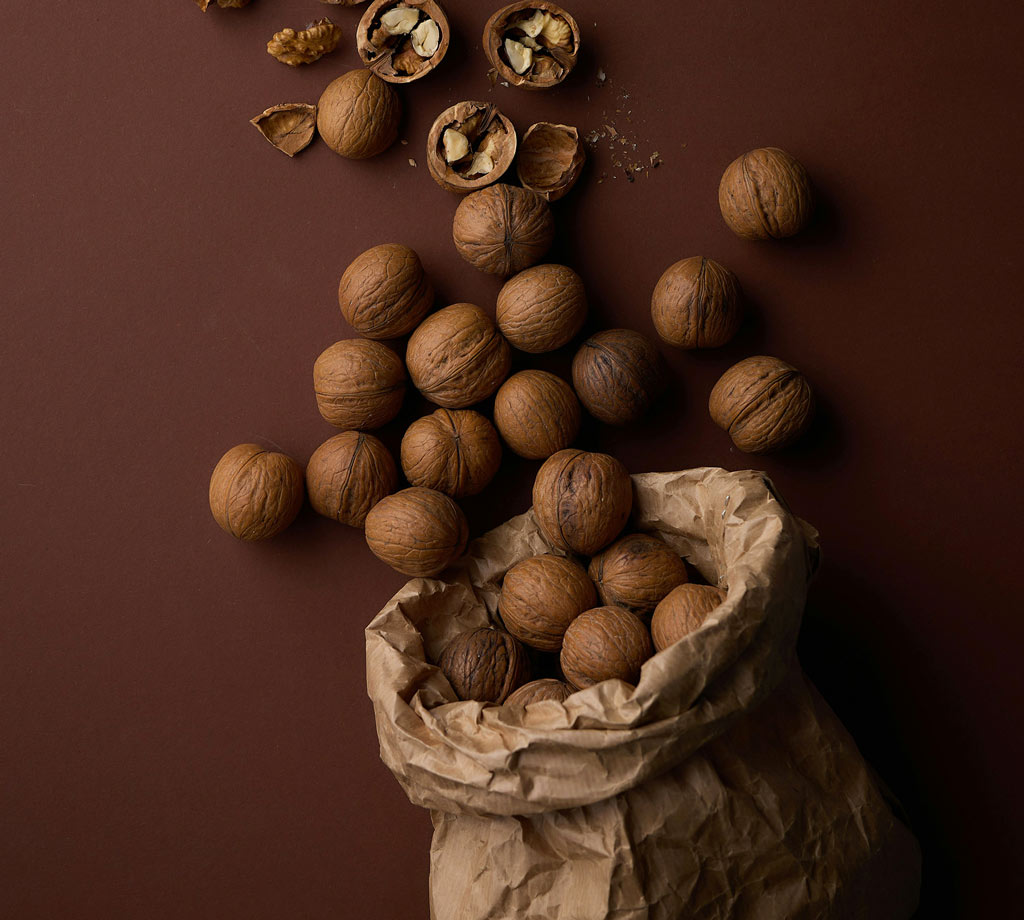
When I think of walnuts, I think of the brownies I bake every year on my birthday—and immediately of my favorite Persian dish, fesenjān, a delicious sweet-and-sour stew with walnuts and pomegranate juice. In English, the walnut is also called “Persian walnut.” The English word walnut literally means “foreigner’s nut.” In antiquity, the walnut was introduced from Persia to Greece and later spread across Europe by the Greeks and Romans. Eastward, the walnut found its way into China via Afghanistan. This nut, which is among humanity’s oldest cultivated crops, is now grown in many more places. France, Italy, and the United States are currently the largest producers of walnuts.
Among the Greeks and Romans, the walnut tree was dedicated to the supreme god Zeus (Jupiter). Walnuts were seen as the food of the gods. The sacred union between the tree and their supreme god is also found in its botanical name Juglans regia, meaning “royal acorn of Jupiter.” The tree has always been associated with death and is widely planted in cemeteries, but the nut was also long used as a fertility symbol at weddings, when walnuts were sprinkled over young brides.
I learned from Belgian ethnobotany professor Marcel de Cleene that, in Europe and Latin-speaking countries, walnut trees were regarded as the favorite haunts of witches. Witches would gather under the walnut tree on June 24, St. John’s Day. Brian Muraresku, author of The Immortality Key, also discusses the walnut tree as a gathering place for wise herbal women, later known as witches. The holiest witchcraft pilgrimage site in the world was the walnut tree of Benevento in Italy, where women gathered from all over Europe. “There they frolicked under the branches, which were sacred to the Greek goddess Artemis. And paid homage to a female divinity who bore many names: the Matromne, the Teacher, or the Wise Sibilla, the King of the Fairies and the Greek Mistress.”
The walnut was considered an oracle tree in ancient Europe, and there were numerous ancient customs during which the nuts revealed prophecies about marriage and life. In Belgium, it is customary to plant a walnut tree when a son is born. My mother planted a walnut tree in the garden of our farm in Wallonia even before I was born. The names Wallonia and Wales still refer to the word walnut. Walnut trees also used to be planted near farms, as the bitter substances and aromas of the leaves kept mosquitoes and flies at bay. Walnut leaves were also hung in cribs for that reason.
Technically speaking, walnuts are not actually nuts. They do not meet the official botanical definition of a nut: a fruit with one seed and a hardened shell, like a hazelnut. Walnuts are actually stone fruits. Yet we’ve simply come to call them nuts.
According to traditional medicine, walnuts are used to strengthen the kidneys, lungs, and intestines. They have warming properties and, therefore, a beneficial effect on the libido. In Chinese cuisine, the walnut is one of the most commonly used nuts. It is a rich source of protein and fats and is highly nutritious.
And, as ancient healers once intuited, the walnut is a provision for the brain.
According to the ancient Doctrine of Signatures healing theory, plants that resemble body parts may be used for healing. The walnut, with its two lobes and convoluted surface, resembles the human brain—and in this case, the resemblance is more than symbolic. As a result of its healthy essential omega-3 fatty acids, the walnut is, in fact, good for the brain.
“Essential” means that our bodies cannot produce these fatty acids on their own, so we must consume them through food. Our brain is composed largely of fat-rich cell membranes, and omega-3s help support their structure and function. These fats also have powerful anti-inflammatory effects and help prevent degenerative conditions such as Alzheimer’s disease, cardiovascular disease, and arthritis.
Walnuts also contain the amino acid tryptophan, which, when consumed, is converted into serotonin—the “mind-boosting happiness hormone” responsible for maintaining a positive mood. In addition, they’re high in antioxidants and fiber. The vitamin E found in walnuts not only helps protect against blood clots but also supports reproductive health and may help prevent infertility and miscarriage.
A well-known home remedy for colds and digestive issues involves soaking young walnuts with their green husks in brandy, often with cloves and cinnamon. The walnut tree itself—with its aromatic, lanceolate leaves and iconic green-then-black husk—has long been revered for its healing properties.
For most adults, the recommendation is to eat one handful (approximately 25 grams or 0.8 ounces) of unsalted nuts per day. Walnuts are particularly satisfying and can help curb hunger for hours. A high-quality walnut oil also makes a flavorful, brain-healthy vinaigrette.
Whether you’re baking brownies, stirring fesenjān, or simply snacking, know that each walnut carries with it a long and sacred history—and powerful nourishment for the mind.
Recipe
FESENJĀN WITH “CHICKEN
OF THE WOODS MUSHROOMS”, POMEGRANATE, AND WALNUT
Serves 4 people
INGREDIENTS
100 g/3.5 oz shelled walnuts
30 ml/1 fl oz (2 T) olive oil, plus extra
1 red onion, chopped
2 garlic cloves, finely chopped
8.5 g/0.25 oz (½ T) cinnamon powder
8.5 g/0.25 oz (½ T) cayenne pepper
200 g/7 oz cooked chickpeas
250 ml/8.5 fl oz vegetable stock
45 ml/1.5 fl oz (3 T) pomegranate syrup
15 ml/0.5 fl oz (1T) maple syrup
fine sea salt and freshly ground black pepper
400 g/1lb (chicken of the woods) mushroom,
Seeds of ½ pomegranate
Rice as a side dish.
Method.
Heat a dry large skillet over medium-high heat, and add the walnuts. Toast them a few minutes until golden brown.
Briefly grind the walnuts in a food processor to a fine crumb.
In a tall, thick-bottomed pan, heat the olive oil over medium-high heat. Add the onion and garlic and sauté for about5 minutes, until they begin to brown. Add the cinnamon powder and cayenne pepper, and sauté briefly. Add the nut crumbs, chickpeas, vegetable stock, pomegranate syrup, and maple syrup. Bring to the boil, and put the lid on the pan.
Let it all simmer and thicken for about 10 minutes. Season to taste with pepper and salt.
By Wouter Bijdendijk & Chef Joris Bijdendijk





Comments