In the Wild and In Captivity
Part 1
The Plumery
If you’re of an age when Walt Disney was producing dozens of nature films and TV segments, you learned a lot about the amoral quality of the animal world. For every breathtaking vista of a desert or savannah or rainforest or winter wonderland, you also witnessed animals hunting other animals, the requisite kill, the sharing of the carcass. That included adorable baby animals our hormones programmed us to fall instantly in love with, who became the prey to bigger, stronger, faster predators. In many cases, Disney also made us watch the prey grown up, repeating the very behavior as predators themselves.
You could take the lessons a Disney production depicted at face value: nature is both beautiful and ugly. It is gentle in the rhythms of new motherhood yet brutal in disposing of a newborn or youngster the mother knows should not survive. It is communal when species come together at a watering hole but tribal when fighting over turf or food resources.
You could go further, anthropomorphizing nature’s creatures. You could pinpoint certain similarities between us humans and animals – the constructive as well as destructive forces that nature both generates and radiates through our shared instinctive and acquired behavior patterns. It can be said that nature boils down to survival, whether in the context of geography, botany, or biology. Within the spectrum of survival, all species, including ours, experience what is necessary, unavoidable, and yearned for – what drives us to act and react.
One of the great teachers of these epic life experiences comes from the avian world. We humans observe and interact with these wild, winged works of art and physics differently from every other species on our planet. Historically, we have treated all wild animals as exotic commodities to be bought and sold, to possess rare value that gives us status, to entertain us – even cruelly – as though they only exist for our odd pleasures.
In more recent centuries we have learned better, and yet, to begin with, it was always about proving human superiority. We called animals “dumb” as if they had no senses or feelings. We referred to those that fly as “bird brains” as if the relatively small size of their heads must hold puny organs, mere engines of instinct.
Even today, with advances in science, ecology, technology, medicine, and their veterinary application, avian species in the wild are subjected to the worst forms of commodification. News item after news item portrays the horrors of smuggling: knocking nests off tree branches and out of hollows, carelessly killing adults to grab eggs or babies, stuffing them into boxes or plastic bags and tubes, under cars, inside clothing – anything to get past border police and customs agents.
Smuggling is illegal. The international bird trade is illegal. Yet nothing seems to stop it. As a result of all the laws passed to protect birds in the wild, only a meager 2% of captured parrots and similar species such as cockatoos are recovered and their smugglers arrested. Documented by avian protection groups and government agencies, other statistics present more shocking facts. Almost a million parrots – adults and chicks – are captured in their native habitats, and the vast majority – as much as 90% – die before entering the marketplace. About one tenth of parrots are killed in netted traps or from adhesive glued to sticks made to look like tree branches. Another quarter to a third of captured parrots die from being crowded in small containers, sedated, and starved.
The legal side of buying and selling parrots is hardly an improvement. Breeding birds has no licensing or regulatory agencies. At the national level, the U.S. Department of Agriculture (USDA) covers farm birds and wild birds used for agricultural purposes. USDA’s Animal and Plant Health Inspection Service (APHIS) oversees damage to wildlife. The U.S. Fish and Wildlife Service (USFWS) helps to conserve avian habitats, manages the Migratory Bird Program, and enforces the Migratory Bird Treaty Act and the Endangered Species Act. At the state level, wildlife and natural resource agencies count avian populations, keep lists of endangered species, and regulate hunting. California has a Department of Fish and Wildlife and a Department of Agriculture that report to their federal counterparts. None have control over breeding practices, sales, or accountability.
Breeders have private businesses, selling to individuals and pet stores. They can sell birds of any age and in any condition at bird mart circuits up and down the states. People with peripheral businesses in bird food, bird caging, and bird toys will tell you that breeder demographics have changed over the decades. Once the majority operated as mom and pop enterprises; they loved their birds and were more careful where they placed their stock. Now the majority are people who simply view birds as objects to sell. Their motive is making a profit.
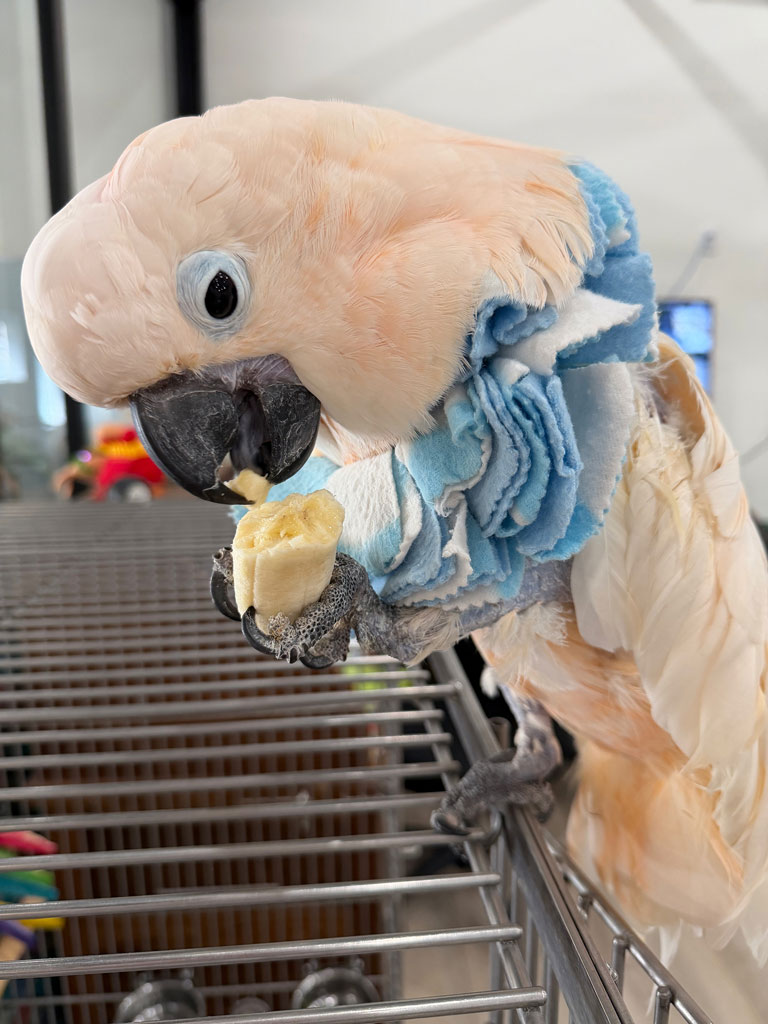
They provide no education about species, how to care for a bird, what the best food is, what to expect when a baby bird matures and changes its personality. They make no recommendations about veterinary care or where avian veterinarians are in the areas where breeders sell their inventory. They will lie to prospective owners, telling them that the specific parrots they’re interested in are quiet birds. If you’ve been to a parrot sanctuary, a pet store where birds are sold, or a zoo, you know all parrots can be noisy and most squawk at top decibel levels.
With all that lack of information, people continue to buy parrots for all the wrong reasons: they want a bird who talks, they want a bird who will entertain them, they want a beautiful bird to look at, they want a parrot to match the furniture… They have no idea that a parrot is highly intelligent, highly emotional, highly possessive, highly loud, has a bite that can shatter bone, is easily frustrated and will even turn on itself and pluck out its feathers when neglected, angry, upset, or confused, and doesn’t get attention ALL the time.
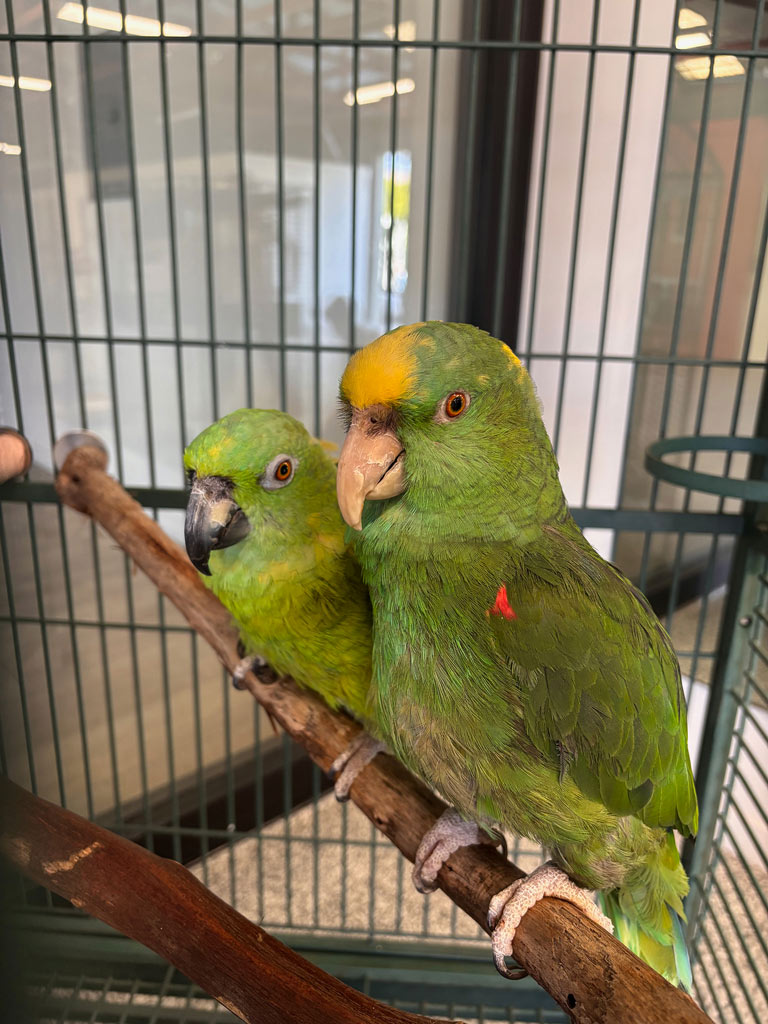
People forget that parrots are hard-wired wild; parrots are not domesticated as are dogs and cats. Parrots can act tame; they are flock-oriented and most mate for life in the wild. As a captive pet, they will bond deeply with one human, imitating what nature urges them to do. Birds are meant to fly, yet we put them in cages – effectively small prison cells – that often don’t have enough room for birds to flap their wings, an action directly tied to their respiratory systems. No flapping = poor breathing.
People rarely even know that many parrot species can live to the age of 60 to 90 years. If parrot behavior doesn’t challenge the average bird owner, then the bird owner’s own mortality ends up challenging its quality of life as a result of a parrot’s own lifespan. Will anyone in the family want Polly Parrot who only loved Grandma and bit everyone else? If Polly is only 30 when Grandma dies at 90, Polly still may have 30 to 60 years of life left, outliving one or more additional human generations!
Why are we still so attracted to the notion and habit of keeping parrots and other exotic avians in homes designed for humans, when it goes against nature to restrict these creatures? What must we learn to better appreciate birds and how they contribute to planetary life? First, avians are not winged, beaked, clawed humans. Yes, it’s human of us to connect some dots and imagine they are a little like us and we a little like them.
But it’s much more enlightened to understand how having wings, beaks, and claws contributes to pollinating whole swaths of land by flying, foraging, and carrying food back to habitats. Seed dispersal and forest regeneration take place because of birds like parrots. Even their droppings fertilize soil that then nurtures healthy plants and crops. We need those millions of parrots, cockatoos, and other birds of the rainforests to keep our planet thriving. We need them IN the rainforests.
It’s also an eye-opener to realize that parrots in their natural territories and habitats behave differently than when captive in human company. We tend to clip wings, thinking we’re protecting our pets from escaping. We’re not only taking away their freedom, but we’re also interfering with the complexities of avian physiology. Even the muscular ability to fully flap wings is tied to the strength of the respiratory system. On the plus side, some bird owners provide outdoor aviaries that are roomier than cages, and some set up safety-netted, free-flight spaces that allow complete exercise and a taste of freedom as in the wild.
Is it truly a matter of safety or really a human fear that a pet parrot will take off and not come back? Is that fear justified? We take parrots and cockatoos out of their natural rainforest settings where they know what to do, where to find food, how to set up their nests, who their predators are. Then we put them in alien environments with different climates, different landscapes, unfamiliar foods, human structures, machines, vehicles. How many birds from Central America, South America, Asia, the Down Under countries, removed from their native habitats, can safely survive?
So protect them we must, since we have forced wild creatures to navigate their long lives in places unsuited to their natural movement and instincts. Parrots and cockatoos in the wild establish territories, strict nesting and feeding practices, and social hierarchies. What do we do in return? For the most part, we rob them of their flock and replace it with a human structure. We ignore nature’s taboos by indulging in hybrid breeding among parrot species that nature doesn’t condone. We care for our parrots by limiting their capabilities as well as their freedoms.
Is the picture all bad? Are we humans so blinded by our own instincts that we can’t do right by these amazing birds? No! We can be protective and responsible. We can share our lives with parrots and still respect their nature and their needs. Part 2 of “What Parrots Can Teach Us: In the Wild and In Captivity” provides the lessons we can learn and apply in THE EDEN’s next issue.
By Leslie Crane Rugg