The Female Right Whale
She is the lifeblood of one of the world’s most endangered whale species. The female right whale carries the future of her kind within her, giving birth rarely yet nurturing fiercely. Her long migrations, deep instincts, and quiet endurance embody the strength of nature and the urgency of conservation. Without her, the right whale’s song could fade forever from the oceans.
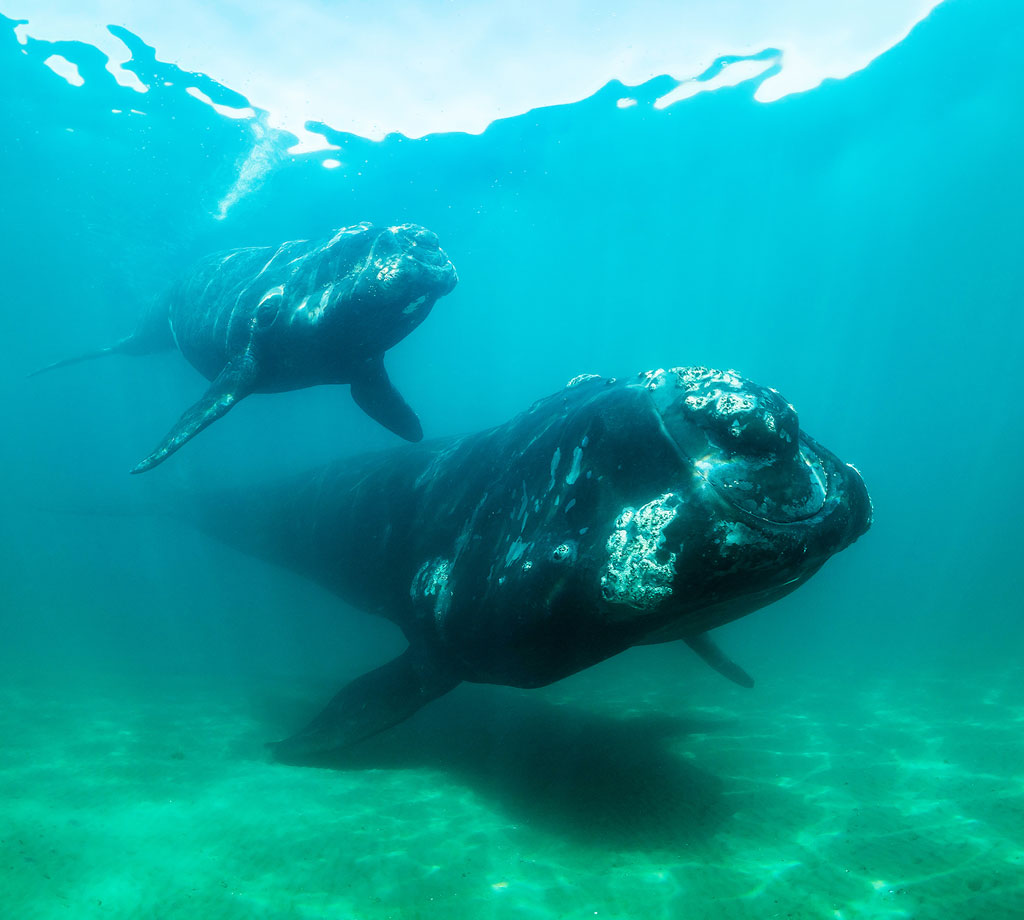
This summer, a couple of female right whales, Curlew and Koala, are serenely grazing on zooplankton in the ocean waters north of Prince Edward Island, Canada, the land of Anne of Green Gables. The elusive cow whale duo made history, turning south from the right whale birthing grounds off Georgia to travel through the Florida Keys into the Gulf, formerly known as the Gulf of Mexico.
Right whales are not known to migrate except for females giving birth to blubber-less calves in warm, nutrient-poor waters. This spring, 11 mother-calf pairs were seen high-tailing it to the plankton-plentiful waters of Cape Cod and the Islands.
Koala, 16, and Curlew, 14, took the more scenic route. In February, they were seen moving back and forth from St. Petersburg, FL, to the panhandle and on to Dauphin Island, Alabama —much to the amazement, awe, and delight of local researchers.
On April 15, about 50 miles East of Miami off Bimini, the Bahamas, there they were, where right whales are not supposed to be. “Breathtaking” was the first word expressed by people on Neal Watson’s Bimini Scuba Center dolphin-watching tour. “I thought it was fake at first. Once in a lifetime moment for sure!” Their debut made history. Twenty-six other marine mammal species have been documented in the Bahamas.
Koala and Curlew are usually seen in Cape Cod Bay in April. But not in 2025.
By May 15, the rambling rights had passed George’s Banks, Nova Scotia, through the Cabot Strait into the Gulf of St. Lawrence and into the ocean waters north of Prince Edward Island. The rights traveled approximately 2,200 miles and averaged 74 miles a day at a speed of 3.3 miles per hour if they were traveling in a straight line from Bimini. Canadian whale researchers spotted them from an aircraft on May 15.
We really don’t know whales at all. When Koala and Curlew left their natal waters off Jacksonville to swim south instead of north, they traveled 1,200 miles to Alabama. However, they lingered for a month between St. Petersburg, Florida, and the Florida Panhandle instead of heading straight there. They raced from St. Pete’s to Bimini in three days and evaded detection by several whale research organizations using aircraft from Georgia to the Gulf of St. Lawrence by staying in areas where they were not expected to be.
The lesson of the roving lasses is that whales have much sagacity, an ability to make sound judgments. They are free to alter their behaviors in response to unfolding situations and act in unexpected ways. Life is organizing and working against entropy, the coming undone of everything to a resting state. To live is to respond adaptively to the unexpected, where the one constant is change.
We must, therefore, step away from our preconceived notions, do less figuring, avoid being bound by recited expectations, and observe more clearly. Like the people standing on Ireland’s second-highest sea cliff, Sliabh Liag, on a Monday in July 2024, when a right whale cruised along the shore, they did not rush to small craft to surround the whale for a better look. Instead, they stood their ground and let the whale feed undisturbed in Donegal Bay. Was this right whale related to the one that summered in Ireland in 1910? Only the whales know.
By Dr. Rob Moir