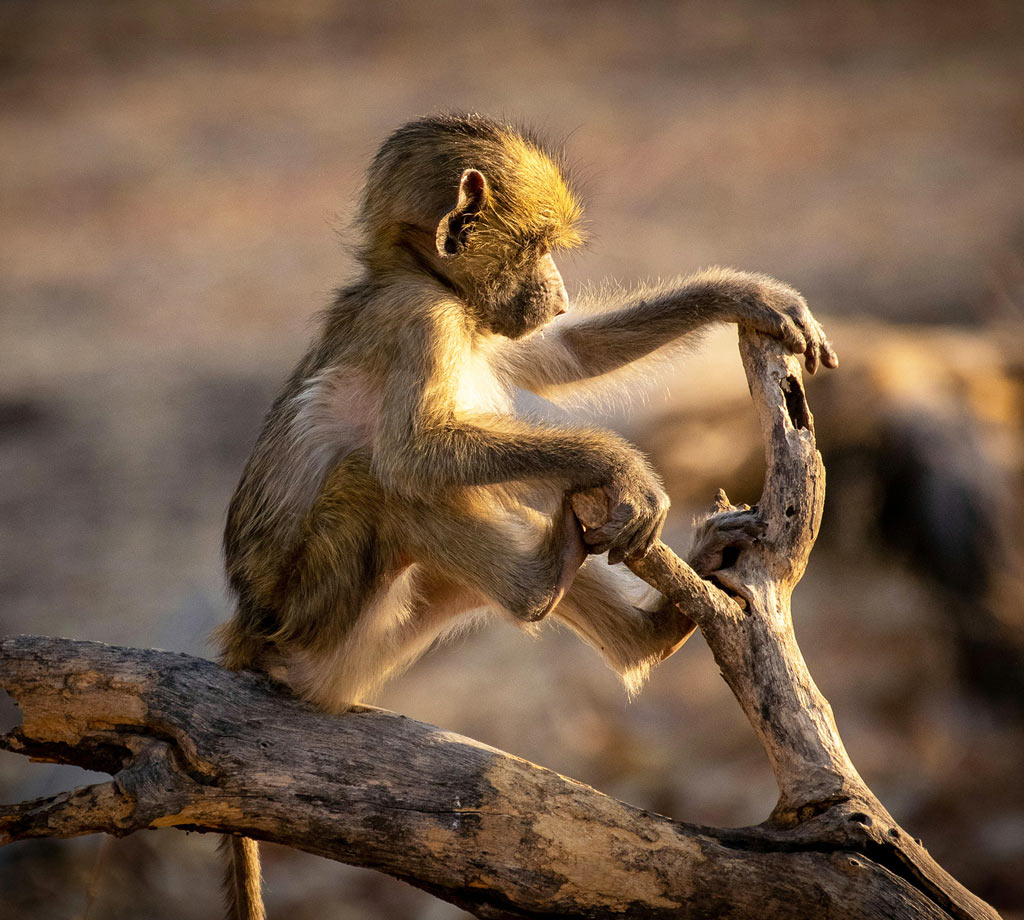
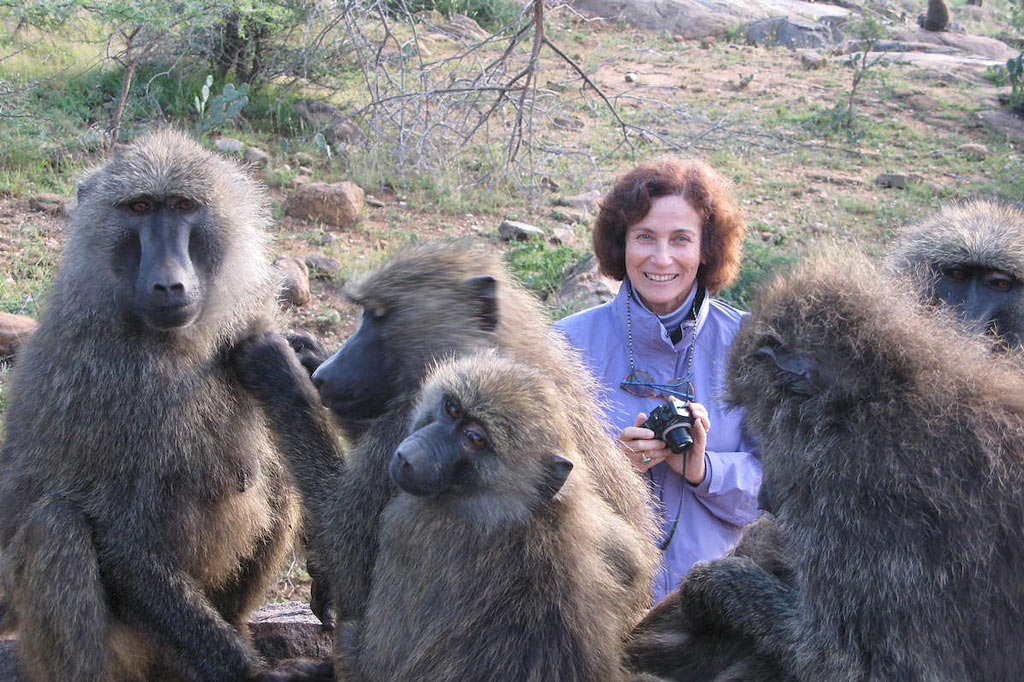
For over half a century, renowned anthropologist Dr. Shirley C. Strum has lived and worked among wild baboons in Kenya, documenting their lives with extraordinary depth and empathy. Her groundbreaking research has reshaped our understanding of primate behavior, evolution, and the very foundations of human society. In her remarkable new book, Echoes of Our Origins: Baboons, Humans, and Nature, Dr. Strum takes readers on a journey that is part memoir, part natural history, part adventure, and part urgent call to action. She challenges long-held assumptions—such as “survival of the fittest”—revealing instead the complex strategies of trust, negotiation, and collaboration that allow baboons to thrive. Through their world, we gain new insight into our own.
It is our great honor to share Dr. Shirley C. Strum with you in this issue, inspiring exploration of life, science, and the deep connections that shape us all.
After living alongside baboons for over fifty years, what has been the most surprising or transformative discovery about their social lives?
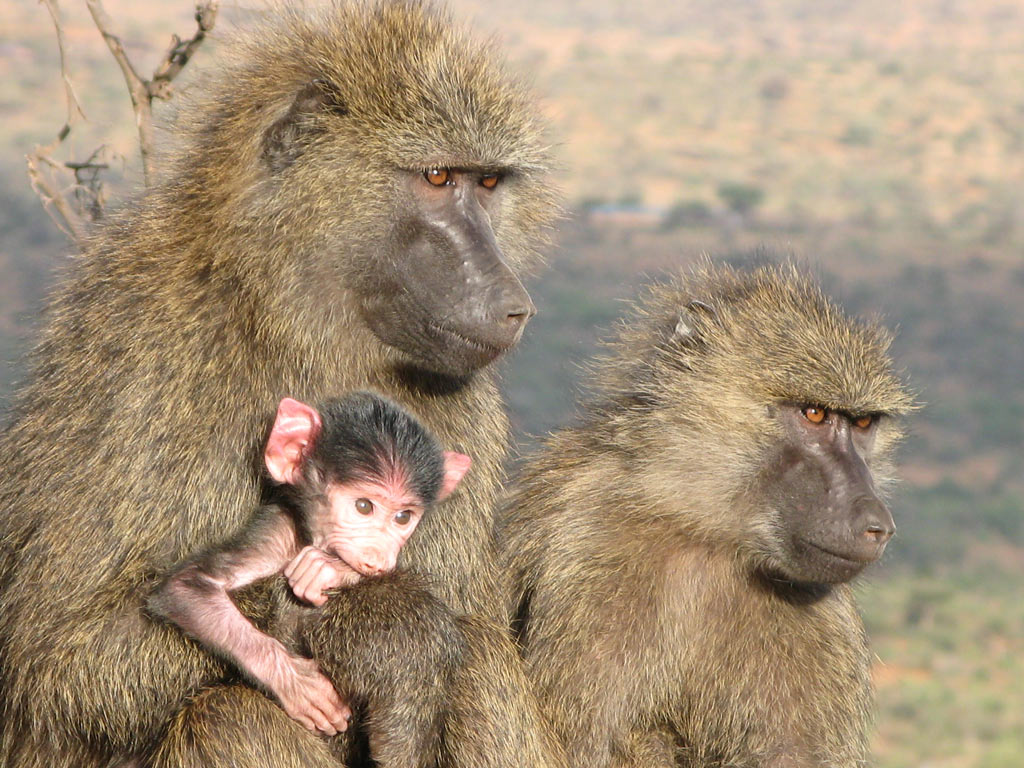
How smart they are and how socially sophisticated. Baboons don’t have symbols, language, material culture, or cooperation, but they still create a social contract, which is much like our Golden Rule: do unto others as you would have them do unto you. This is because baboons need each other to survive, perhaps even more than modern humans do. Aggression is risky, so it makes sense that baboons avoid aggression except when they can’t. Instead, they have “social strategies of competition and defense,” which are far less risky and, if not more effective, at least equally.
In Echoes of Our Origins, you argue that science must evolve beyond rigid frameworks. Can you share a moment from your research when traditional assumptions failed to explain what you were witnessing?
I was trained as an ethologist in the late 1960’s. That meant the behavior of wild creatures could explain everything without reference to emotions, mind, and personality. But I kept feeling like the essence of what I saw was falling through the cracks until I realized that my extra notes weren’t just anecdotes, but they were data. They were Darwinian natural history, systematic and detailed. Natural history observations let me put together what science had taken apart in the search for underlying explanations. For example, I moved 3 troops of baboons from their home to a new place that was much wilder and more arid, where they knew only about 50% of the foods they needed to survive, and a few that provided drought foods. Importantly, there were elephants in the new place but not in the old home, and baboons were frightened of them. Wouldn’t you be when you encounter wild elephants without the safety of your home or vehicle? The next morning, I couldn’t find the baboons where I had left them, but noticed elephant footprints around their sleeping rocks. When I questioned the few other humans living in the area, they said they had seen baboons moving in the dark, away from their usual sleeping site, to another set of sleeping rocks about 2 km away. Sure enough, they were there. My quantitative data documented the shift in the baboons’ location, but I couldn’t have explained why this group shifted without my natural history and my interpretation that the baboons avoided the elephants. I might have come up with many interpretations of why they shifted their home range, but none would be
correct.
Many still view evolution as “survival of the fittest.” How have baboons—and your decades of work with them—reshaped your understanding of what truly drives evolution?
The baboons demonstrated many times that evolution is much more relaxed than we assume. There is greater variation between individuals, greater tolerance for mistakes, and greater space for adaptability. It is “survival of the fit enough,” where fit enough includes more room to maneuver than we thought. I saw this when the troop first split in 1981 into raiders and non-raiders. The raider males included adolescents, but not all adolescent males became raiders. The raider females included those who had friendships with the raider males, but not all of them. Even among females who became raiders, not all their families joined the raiding troop. I had worried before about how the “fittest” could be defined. Was it survival of your infant (to when?), its infant, or several more generations? Much later, a group kept getting mobbed but returned, which they weren’t “supposed” to do. Mobbing says, “get away from here,” so returning was strange. Also, mobbing took its toll in terms of female and infant deaths. Eventually, they moved back to their favorite sleeping site, but that was 6 years later. I don’t think baboons can plan 6 years in advance. Watching and tracking baboons really changed my ideas about how evolution operates.
Baboons have developed remarkable systems of negotiation, collaboration, and trust. What lessons from their society might humans apply to our own challenges with relationships, conflict, and community?
Although it is in vogue to attack human exceptionalism, I see it differently. Of course, there is continuity, so I expect the origins of culture or symbols in other species, particularly other primates. Yet humans have changed the process so much that what we have today is very, very different from what we find in other animals. Humans can lie, cheat, and exploit others with their language, symbols, culture, and social cooperation. That is why I jokingly say that I would rather have a baboon as president than a human. I think humans have lost the essence of what made us so successful: our socialness, the social and brain structures that made cooperation possible. Today, humans have changed how we interact, and not for the better. Yet underneath it all, the same things matter: trust, cooperation, and community. We need each other to succeed, or rather, we succeed better when we cooperate (baboons only collaborate, I think). Watching baboons showed me how far a society can go without these essential human properties. Baboons don’t have an aggressive society. They don’t have a male-dominated society. Females inherit dominance status, but males pop out of the female hierarchy by the time they become adolescents. Yet both males and females have alternatives to aggressive ways of doing things, which they use to buffer what might become raw aggression. We tend to look to animals for the worst human behavior, but we should not because we, humans, have created our own worst behavior.
You’ve witnessed firsthand the consequences of human-wildlife conflict. What steps can individuals, communities, or even policymakers take to foster genuine coexistence with the natural world?
First, if people are part of the problem, people have to be part of the solution, as the Community-Based Conservation philosophy states. We can’t expect people living on the margins of survival to sacrifice in order to save a tree, a species, or a habitat. That means wealthy individuals and wealthier nations need to create new options so that marginalized people don’t suffer if they act for conservation’s aims. Second, coexistence is based on compromise, and until now, humans have taken space without asking or compromising. Wild creatures and their habitats have suffered. But coexistence turns a win/lose situation into a win/win outcome by having both sides compromise. Humans must now compromise in their expectations and their actions because so far, they haven’t. Finally, the future of wild creatures and wild places depends on us, humans. More than ever, it is about what we think about nature and wildlife and what we are prepared to do to co-exist.
We have to renegotiate and reimagine our relationship with nature. I have hope because of the changes I have seen with new options for the local communities that are the baboons’ neighbors. I also see changes in my students. Earlier (I have taught for 50 years), students cared about wildlife but not about the communities that live with wildlife. Now they care about both and are willing to make sacrifices if they think it will help humans to co-exist with the natural world. These changes might not be fast enough, but they are in the right direction.
Your book blends memoir, science, and advocacy. What do you most hope readers will take away—not only about baboons, but about themselves and their role in this shared world?
Everything has changed in the 50 years of my career watching wild baboons. Baboons aren’t the way we thought they were (and certainly don’t deserve the current bad rep they have). Studying baboons convinces me that there are many more sophisticated and smart animals out there that haven’t been studied or for so long. This means when we lose a group or population or species, we lose much more. I’ve seen that human-baboon conflict (and perhaps all human wildlife conflict) is usually the fault of people. However, it is very difficult to change human behavior, so the wild creatures pay the price. Baboons are smart and sophisticated, and not dominated by males. Instead, they rely on friendships to create trust and to employ social strategies of competition and defense. The world would be a nicer place if we imitated baboons a bit more.
Human/baboon conflict is inevitable due to the growth of the human population (in Kenya, more than 5 times its size over the last 50 years) and the conversion of wildlands to agriculture, as well as urban, suburban, and rural development. This puts pressure on all wildlife, including baboons.
But baboons are a special case. They are adaptable, smart, sophisticated, and wily. Human foods, whether field crops or manufactured, provide a dense, easy-to-digest, and nutritious alternative to natural foraging for baboons. That means that the best strategy for baboon raiding is to stop it before it starts. Once it starts, it is hard to extinguish, just like human behavior is hard to change. Furthermore, anti-raiding strategies depend on their history and current context. In all cases, the costs have to exceed the benefits. Baboons don’t eat human foods out of spite but because it is a good foraging decision.
There are several techniques for reducing or ending baboon raiding, but these involve human effort and money. The last option is killing them. However, that isn’t easy, and another group in the population is likely to fill the vacancy.
The conflict between baboons and humans won’t change unless human behavior changes as well. But the anti-raiding strategy must be tailor-made, remembering that there are a range of cultural responses. The current lack of clarity is not about animal rights and welfare, but about how to assign “responsibility” for the actions and “who will do it?” This means we need to rethink the relationship between baboons and people, and humans and nature.
An excerpt from Echoes of Our Origins: Baboons, Humans, and Nature, by Dr. Shirley C. Strum
I have given much thought to the moral, ethical, and practical issues that inevitably arise when you study creatures in the wild whose lives would be longer and healthier if you’d chosen to make them so. Especially when they’re close biological cousins, whose ways so often seem eerily similar to ours. Moreover, how do you follow three and sometimes more baboon troops who travel many foraging miles each day and may go places where a fused back is a distinct liability? Who will watch the baboons when you can’t be there? You have a team, and their safety is a consideration, aside from concerns about consistent data collection. It’s the management side of science in the wild, and it too comes with rewards as well as challenges.
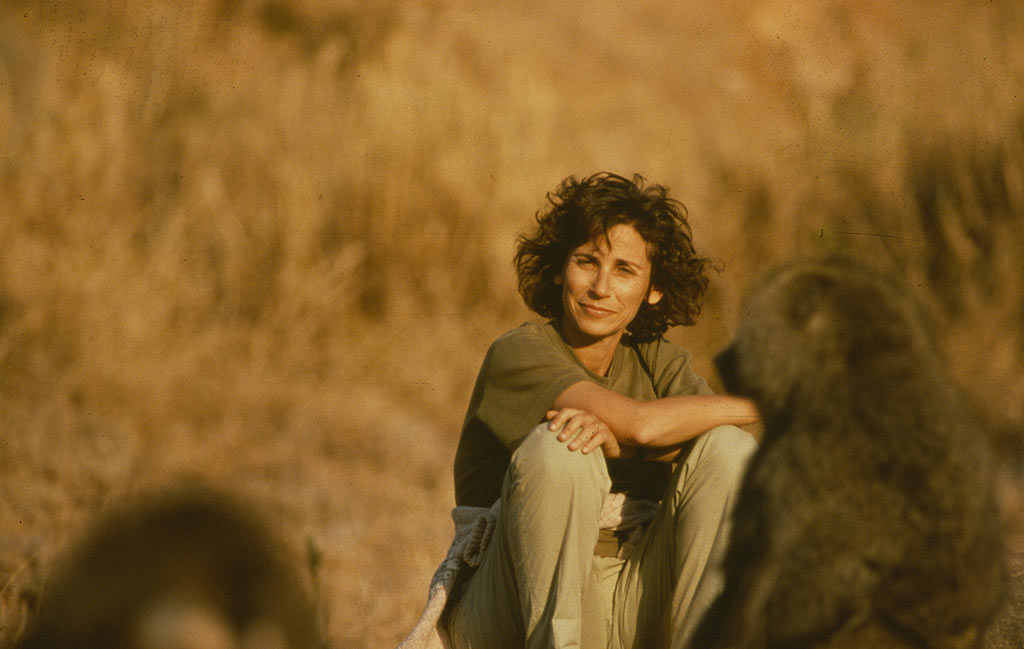
There are no simple answers to any of these issues, but my scientific goals help with clarity. The point of my studies has been to discover patterns of behavior that tell us both about what baboons do and why. If, for example, I decided to break up fights, play with youngsters, or medicate the injured, I would have to question the authenticity of the behaviors I saw. I have wondered if the team and I hovering around the troops for so many years might have caused a subtle loss of naturalness. Was it always “normal” behavior we were seeing, or possibly something else, perhaps the result of cumulative micro-interventions over decades, or a loss of healthy wariness toward humans. In any case, after moving the baboons, I doubled down on my noninterference policy because the study was now a test of baboon survival and adaptability. We needed to know whether translocation would work as a conservation and management strategy, not just for baboons but also for other primates. I fully subscribe to the critical importance of following standard rules about field research. Scientific rigor is essential, and credibility is at stake. But rules don’t erase feelings, and at times I’ve felt torn in two. I have learned that as losses accumulate, grief becomes a sort of shadow companion. Thoughts of Peggy’s death or Wiggle’s still bring tears to my eyes. I have found that grief is assuaged more effectively by distance than time. When I’ve returned to California and had classes to deal with, I don’t dwell. But back with the baboons, I’m faced with reminders.
The death that affected me most deeply, after Peggy’s, was that of Zilla. She was the last of the old females who’d come over from Kekopey, and the top female in Malaika. Like Peggy, Zilla was special, possessed of baboon charisma, at least for me. She was smart, social, and held her own when challenged. She felt almost like a friend, if friendship can be unrequited. She was 22 when she died, quite a bit younger than Peggy, who was at least 32 when she fell from the cliffs at Kekopey. But life on Chololo was harder, and females aged quickly.
In 1997, during a drought that followed several years of drought, Zilla was was clearly suffering. Her eyes were sunken, her hair unkempt, her manner listless. One evening in early March, she was missing as the rest of the troop began their climb up the sleeping rocks. For three days, we didn’t see her. The troop made do without Zilla’s almost preternatural ability to find the best available food that others had missed—acacia seeds or the first green flush of grass on an old boma site. When food was plentiful, her knowledge mattered less, but in times of scarcity, it was crucial, as locating a lone Acacia etbaica tree in flower could be lifesaving.
We assumed Zilla had died, and I felt a terrible heaviness. On day four, the team and I walked with the baboons to a gully where a temporary human encampment now sat. There, shockingly, was Zilla, but not the Zilla of four days ago. She was even more gaunt, and her face was crisscrossed with dried blood. Matted hair at both temples partially covered nasty-looking injuries. Her lower face, around the jaw and chin, was swollen and disfigured. I saw traces of maize on her lips and figured her cheek pouches were full. Most likely, she’d been attacked by dogs after finding stored maize at the boma. As we approached, Zilla turned to leave the boma. She made no effort to rejoin her troop. But as she rose, she lost her footing and fell. She pulled herself up and took a few halting steps, looking like the proverbial drunken sailor. There were no visible injuries on her legs and hips, but her weakness told me she was probably close to death. I asked the team to stay with the troop as it moved around the boma and away from the barking dogs. I followed Zilla, glad to be on my own. I’d had trouble concealing my distress at the sight of this wonderful female in such dire shape. Even writing these words is difficult. I quietly trailed Zilla as she staggered a hundred feet or so to a tree where she sat and rested in the shade. She roused herself up once more, lurched forward for a few dozen feet, then stopped and rested again. At this point, I cracked, no longer able to hold back tears, my heart broken by her sad, valiant determination to keep moving. And yet . . . the scientist in me wondered why she kept going. She seemed intent on getting somewhere, as if aiming for a particular destination.
During her brief rest breaks, Zilla worked to chew the maize still in her mouth. Normally, crunching the hard, dry kernels into meal would be easy. Now, with her jaw so swollen, the kernels fell from her lips despite her efforts to push them back in. Then, once again, she’d hoist herself up and make her way forward, always with seeming intention. For nearly an hour, I watched the painful process, wanting desperately to rush to her aid, yet knowing I should not. Something was happening here,and I had a hunch about what it was.
I followed Zilla as she struggled up a small rise. If she was aware of my presence, she gave no sign. As we crested the hill, I saw her target, a rare drought season sight on Chololo: a large, flowering acacia tree. In this food desert, it loomed like a mirage. I did not know this tree was there, nor was it visible at any point during Zilla’s journey. But Zilla had been aiming for it, and she got there by dead reckoning. Her body was failing, but her food-finding genius was intact.
But now she faced her greatest challenge. The acacia flowers bloomed at the tip of thin branches that, standing on tiptoe, I could not reach. Getting to those flowers would be no problem for a healthy baboon, but Zilla was far from that. Frail as she was, she managed to get into the tree and pluck a few blossoms, but she nearly fell more times than I care to count. I stayed with her until late in the day, when I had to get back to camp. The next day, I returned to the tree, but she wasn’t there. I never saw her again. Her last gift to me was a scientifically valuable depiction of baboon intelligence and grit.