
What if the food we throw away could become a lifeline for someone else?
That simple question lies at the heart of 412 Food Rescue, a Pittsburgh-based nonprofit transforming the way communities think about food waste, hunger, and sustainability. Since its founding in 2015, the organization has built an innovative model to rescue fresh, surplus food and get it quickly into the hands of people and communities experiencing food insecurity, proving that what is considered “waste” can still have extraordinary value.
Powered by more than 22,000 volunteers, 412 Food Rescue has diverted more than 31 million pounds of food from the waste stream in Western Pennsylvania, equivalent to more than 26 million meals. Its impact extends far beyond Pittsburgh through Food Rescue Hero, the organization’s proprietary technology platform, now used by 17 food rescue organizations across the United States and Canada.
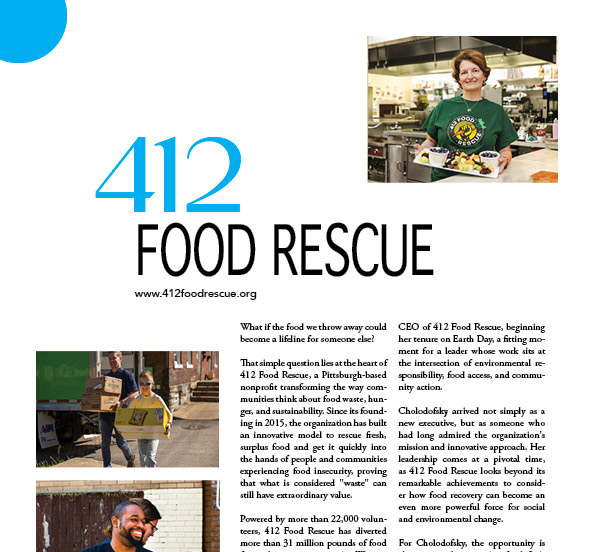
At the center of the organization’s next chapter is Alyssa Cholodofsky, a seasoned nonprofit leader with more than two decades of experience in the sector. In April 2024, she became CEO of 412 Food Rescue, beginning her tenure on Earth Day, a fitting moment for a leader whose work sits at the intersection of environmental responsibility, food access, and community action.
Cholodofsky arrived not simply as a new executive, but as someone who had long admired the organization’s mission and innovative approach. Her leadership comes at a pivotal time, as 412 Food Rescue looks beyond its remarkable achievements to consider how food recovery can become an even more powerful force for social and environmental change.
For Cholodofsky, the opportunity is about more than rescuing food. It is about rethinking systems, mobilizing communities, embracing innovation, and recognizing the dignity that comes with ensuring that good food reaches people rather than landfills.
We spoke with Cholodofsky about her journey to 412 Food Rescue, the power of collective action, the role of technology in solving complex social challenges, and her vision for an organization that turns surplus into sustenance and possibility.
You came to 412 Food Rescue with more than two decades of nonprofit leadership experience and were already a longtime admirer of the organization. What inspired you to take on the CEO role, and what did you see in 412 Food Rescue that made you want to become part of its next chapter?
In many ways, coming to 412 Food Rescue brought together two parts of my career. My early professional experience was rooted in environmental work, something I have always cared deeply about. I then spent more than two decades in human services, much of it focused on designing and securing funding for basic-needs and safety-net supports that help people move toward greater stability, self-sufficiency, and opportunity.
412 Food Rescue sits at this wonderful intersection of environmental sustainability and basic human need. We take perfectly good surplus food that might otherwise go to waste and connect it with people and communities that can use it.
I’ve admired the organization for years because the 412 Food Rescue team hasn’t simply addressed a problem; it’s rethought the system. I saw an opportunity to build on that innovation, strengthen the organization behind it, and help shape its next chapter.
Since stepping into the CEO role in 2024, what have been your top priorities, and how would you describe 412 Food Rescue’s evolution under your leadership?
One of my biggest priorities has been ensuring the organization is as strong as the ideas behind it. 412 Food Rescue grew quickly from a grassroots effort into an organization with significant local impact and a technology platform reaching communities across North America. As you grow, your systems, culture, and financial model have to grow with you.
We’ve focused on strengthening operations, investing in our team and culture, becoming more data-driven, and clarifying our strategy and how we measure success. At the same time, we’re continuing to push ourselves to think bigger about what’s possible.
I see this chapter as moving from proving a great idea works to building the organization and infrastructure that will let it last and have even greater impact.
412 Food Rescue has diverted more than 31 million pounds of food in Western Pennsylvania, while the Food Rescue Hero network has expanded across the U.S. and Canada. What do you believe is key to turning a local grassroots solution into a model that can scale nationally?
I believe you have to understand what’s universal about the problem while respecting what’s unique about each community. The basic challenge exists everywhere: businesses have good surplus food, community organizations have people who can use that food, and there often isn’t an efficient way to connect the two.
But we’ve learned that scaling doesn’t mean recreating Pittsburgh somewhere else. Local relationships matter. Each community has its own food donors, nonprofit organizations, volunteers, funders, and local leaders. The goal is to give communities the tools and support to build a food recovery network that works for them.
For me, that’s the key to scale: build something that can travel, but keep the solution local.
Food waste and food insecurity are often treated as separate issues, yet 412 Food Rescue demonstrates how closely connected they are. What do you wish more people understood about the relationship between food waste, hunger, and environmental sustainability?
I wish more people understood that the challenge isn’t simply whether we have enough food but how food moves through our system.
Businesses are discarding perfectly good food while families in the same communities struggle to afford groceries. And when that food goes to a landfill, it comes at an environmental cost, too. These aren’t separate problems. They’re connected.
Food recovery allows us to address all of those issues at once. But ultimately, the goal is bigger than rescuing more food. We want to help create a more circular food economy, where surplus food is treated as a resource and redistribution becomes a normal part of how our food system works.
With more than 22,000 volunteers and hundreds of food retailers and nonprofit partners involved, 412 Food Rescue depends on an extraordinary community network. What have you learned about motivating people to turn their concern about hunger and climate change into meaningful action?
People want to help. The challenge is giving them an easy, meaningful way to do it. That’s one of the things I love about our model. A volunteer can open the Food Rescue Hero app, find a rescue that works with their schedule, pick up surplus food, and deliver it to a nonprofit partner. In a short time, they’ve done something tangible for both their community and the environment.
Hunger and climate change can feel like enormous problems. But when you can say, “Here’s something I can do today,” it changes the equation. And when thousands of people take those individual actions, they create something much bigger together.
Technology is a major part of 412 Food Rescue’s approach through the Food Rescue Hero platform. How do you see technology and innovation changing the future of food recovery, and what opportunities do you see for expanding the platform even further?
Technology helps us coordinate something that is inherently complicated. Surplus food becomes available in different places, at different times, and in different quantities. Technology can connect that food with volunteers and nonprofit partners in real time.
Where I think it gets really exciting is what we can learn from the data. We can better understand where surplus food exists, where community needs are greatest, and where gaps exist in food recovery. That information can help nonprofits, funders, and communities make better decisions.
I also want this technology to become accessible to more organizations, including smaller communities that may not have the resources to invest in sophisticated systems. Innovation has the greatest impact when more people can actually use it.
As CEO, what are some of the biggest challenges you believe 412 Food Rescue, and the nonprofit sector more broadly, must address in the coming years, particularly as food insecurity and food waste continue to affect communities?
Nonprofits are being asked to do more at a time when resources are increasingly constrained. The need isn’t going away, and in many communities it’s growing. We have to find more sustainable ways to support the organizations and systems people rely on. I also think we need to change the way we talk about the role of nonprofits. We’re not simply filling gaps. In many cases, nonprofits are essential community infrastructure. Food access is a great example.
And none of us can solve these challenges alone. We need government, philanthropy, businesses, and nonprofits to work together and think beyond individual programs toward long-term solutions.
Looking ahead, what is your vision for 412 Food Rescue five years from now, and what would success look like for you, not only in pounds of food rescued, but in the lives and communities the organization can impact?
I certainly want us to rescue millions more pounds of food, but pounds can’t be the only measure of success. Five years from now, I want food recovery to be a normal part of how communities operate. If a business has good surplus food, there should be an easy, reliable system for getting it to people who can use it. Locally, I want us to continue building that system in Western Pennsylvania, and nationally, I want Food Rescue Hero to make that kind of infrastructure possible for communities everywhere.
And I want us to understand the impact beyond the pounds. Are more people accessing nutritious food? Are our nonprofit partners stronger? Are we reducing environmental impact? Are volunteers more connected to their communities?
Ultimately, success would be getting closer to a world where throwing away perfectly good food feels like the exception rather than the norm.
Food Rescue Hero has become an important part of 412 Food Rescue’s ability to connect surplus food with communities in need. What inspired the platform, and what excites you most about Food Rescue Hero’s future as it continues to grow?
Food Rescue Hero grew out of a very practical challenge. Traditional food recovery often relies on trucks, drivers, and scheduled routes, but surplus food doesn’t necessarily appear on a convenient schedule. The innovation was recognizing an enormous transportation resource in our communities: people going about their everyday lives.
Technology made it possible to mobilize those people. Volunteers can see available rescues, choose one that works for them, and help move food from a donor to a nonprofit partner.
What excites me now is taking what we’ve learned and making it available to many more communities. I see Food Rescue Hero becoming more than a technology platform. It can connect communities across the country around a shared approach to food recovery, while giving each community the flexibility to make it their own.
And one personal question: after spending so much of your career working to make the world a better place, what is one simple thing that never fails to make you smile or brighten your day?
I love those heartwarming moments when you see someone achieve something they’ve worked toward. It can be a major life milestone or something very small. There’s something about seeing that moment of accomplishment and joy that always brightens my day. Maybe that’s part of why I’ve spent so much of my career doing work centered on helping people create opportunities and reach their goals.
And on a much simpler level, put me outside on a beautiful sunny day surrounded by nature, and I’m happy. Sunshine, fresh air, and the beauty of the natural world always restore my energy and perspective.





Comments