
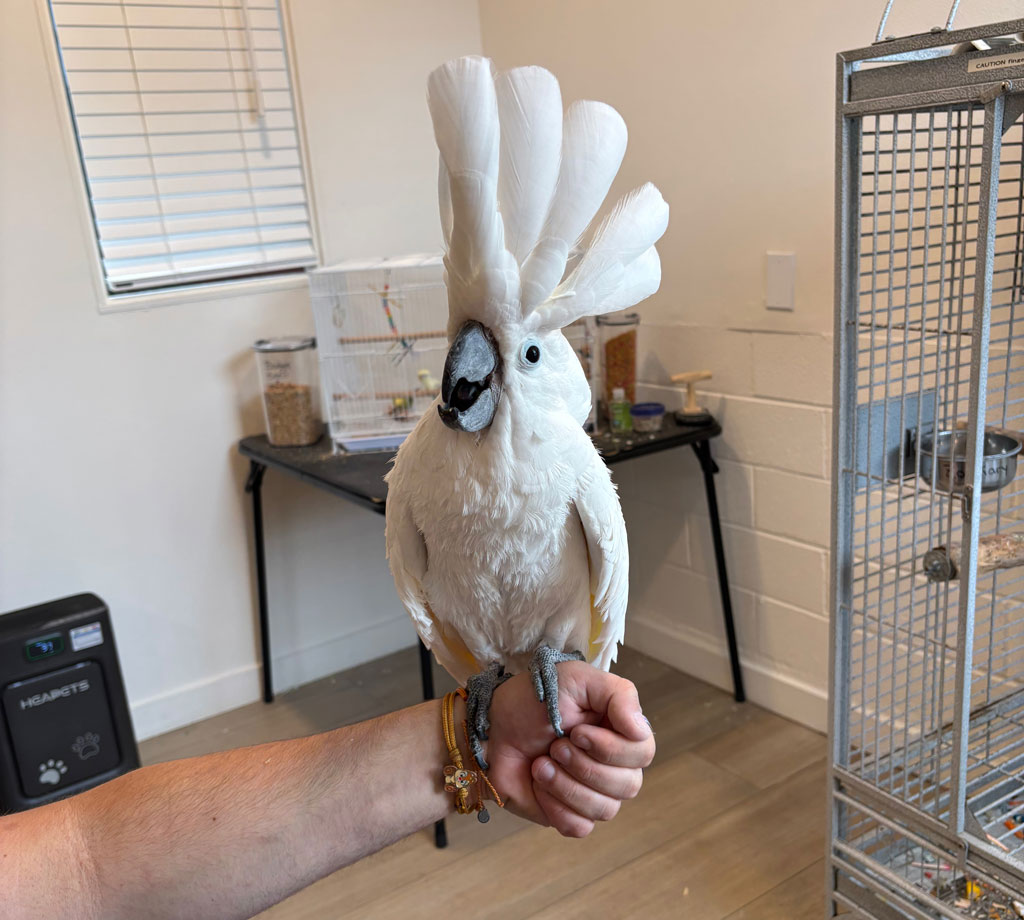
First and foremost, observation and communication are the tools humans have depended on to ask the big questions and find answers about life in all its forms. It’s no different when we attempt to understand each other as well as other species. It’s especially rewarding when dealing with creatures who can intelligently speak our language as well as imitate it. How have we managed to successfully observe and communicate with parrots? Have most parrot owners taken the time to understand or interpret what their birds try to tell them? Indeed, every squawk has meaning.
On the negative side, look at how many social media videos go viral when parrots act like humans – mimic our language, either swearing or singing operatic arias, wear miniaturized costumes we sew to emulate heroes or poke fun as haters, ingest food or substances that will make a bird sick, push them to display behavior so like our own emotions of anger or delight? How does that benefit a parrot and what does that say about the inherent egotism and impulsive cruelty of human nature?
On the plus side, read about the serious studies researchers have conducted to discover how African grey parrots, for example, sophisticatedly manipulate human language. Dr. Irene Pepperberg’s seminal 30-year project with Alex, named from the acronym Avian Learning Experiment, began at Purdue University in the 1970s and opened the door for continued university research at Northwestern, Arizona, MIT, Brandeis, Harvard, Georgia, Cornell, and now abroad at the Austrian Academy of Sciences.
Let’s stay positive and make the assumption that you take responsibility, do your homework, and prepare everything necessary to enrich the life of a parrot in your home and yard. If you’re thinking of getting a parrot, what should you first learn about the species and your specific bird? Start with the mental framework of schooling yourself.
Get educated in the basics:
Avian/Parrot Physiology:
Learn about your parrot’s body and all its systems. Remember a bird is not a human covered in feathers. Birds are different and fragile. We take for granted many items in our homes that are toxic to parrots. Be ready to study bird droppings as one way of diagnosing health or disease. Learn when and why female parrots lay eggs or become eggbound.
Avian/Parrot Gastronomy:
Learn what foods suit your parrot and what to avoid at all costs. Different species require different foods, and don’t be fooled by commercial pet stores intent on selling you bags of seed as an appropriate lifetime diet.
Avian/Parrot Psychology:
Learn how birds learn. Observe your parrot in a variety of situations both day and night. Practice classic conditioning and response techniques. What is your parrot trying to get you to do and understand? Get inside that bird brain to figure out how a bird thinks. What behavior does your parrot display for hunger, for comfort, when frustrated, when scared, when happy? What do you do that triggers your bird to react positively or negatively? What differences do you see when your parrot is caged or given free time – outside the cage, in the home, in an outdoor aviary? You know your parrot loves you, so why does it also bite you?
Avian/Parrot Construction
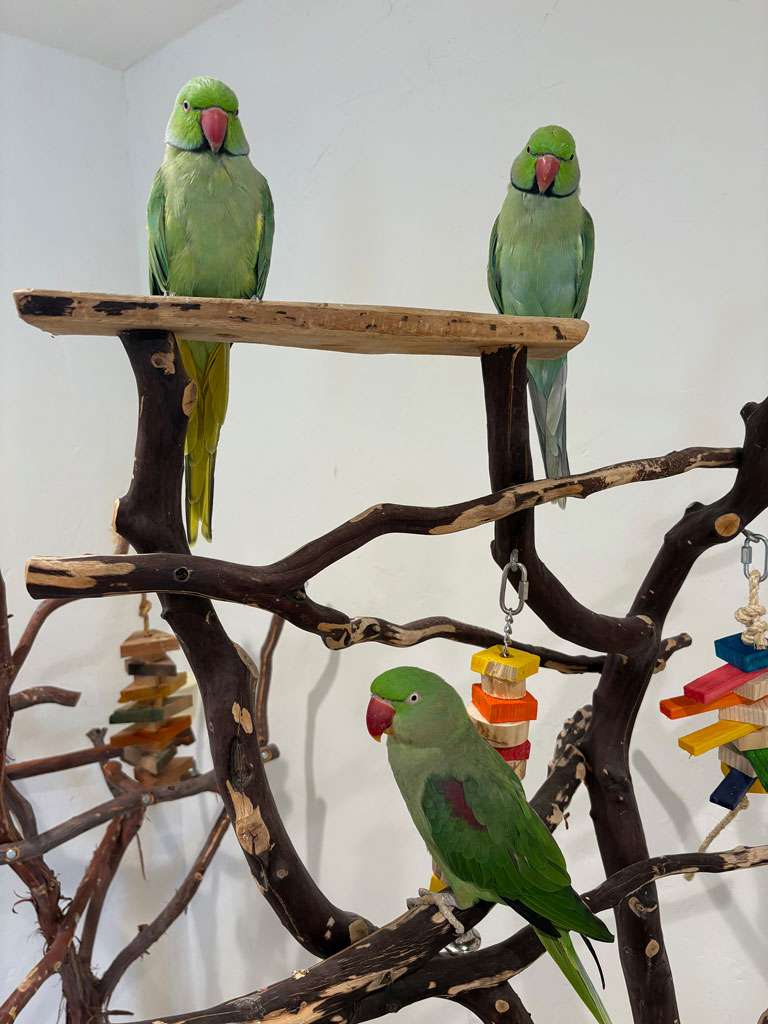
Learn the right size housing for your parrot’s species, based on wingspan and age. Can you provide diversity? A place to sleep, to perch, to forage, to fly, to exercise? Birds like to climb, be high up, have a bath or shower. Parrots like toys appropriate to their jaws/beaks; destroying their toys is more than half the fun. Learn to make toys from natural materials.
Avian/Parrot Civics
Learn when to make rules and when it’s okay for your parrot to break rules. Pay attention because your parrot may also make rules that you shouldn’t break or suffer the consequences. Will you let your parrot on furniture? Will you let your parrot on your arm? Your shoulder? Will you be fair and patient with your feathered alien who must learn everything about humans to survive in our world?
What does it come down to in our desire to share life with an exotic wild creature? Truthfully, birds live the life they’re supposed to live in nature. At the same time, even in the wild, some birds need human intervention – if their habitats have been destroyed, if disease can be controlled or conquered by avian veterinary medicine, if their species is endangered. The best thing you can do is to appreciate birds in the wild and support conservation efforts.
But with the human impulse to possess things, own things, AND bond with animals, it may prove impossible to eliminate illegal smuggling and commodified breeding. We want what we want when we want it, and the marketplace supplies what we demand. So if you decide that a parrot is the right creature to share life with, be responsible from the get-go.
To get a stark view of reality, go on the internet to understand the depth of the parrot problem. You’ll see dozens – hundreds – of photos of all species and hybrids of parrots. You’ll see prices that make you gulp. And if you’re naive enough to proceed and buy from the internet, the bird you actually get is likely not to be the same parrot in the photo.
You’ll also see parrots for sale who have already been in one, two, or more homes. The cycle of rehoming and abandonment, resale and relinquishment, is very real and brutal to creatures who thrive on routine and the familiar and live a very long time. Don’t get caught in this loop. Don’t reinforce the commercialization of animals who have not evolved to live with humans.
What you can do – if you’ve schooled yourself and done all your homework – is to adopt a parrot from a reputable sanctuary or rescue.
– Reputable means a legal nonprofit, an organization or entity well connected with other sanctuaries/rescues or shelters and local avian specialist veterinarians.
– Reputable means having you go through a process of meeting potential parrots that match your lifestyle and capabilities.
– Reputable means requiring you to interact with parrots until it is clear one chooses you.
– Reputable means being trained how to approach, handle, feed, care for, and understand your parrot.
– Reputable means providing resources for you so you won’t end up so frustrated with your parrot – and your parrot with you – that relinquishment back to the sanctuary/rescue becomes the only viable solution.
– Reputable means promising to provide – once again – a haven and quality of life for a parrot when you can no longer care for your feathered friend.
That is exactly why havens for parrots like The Plumery exist and exactly what happens at The Plumery. We give parrots in situations of neglect, misunderstanding, abuse, hoarding, or abandonment a second, sometimes third or fourth, chance to regain health and quality of life. We work with avian specialist veterinarians; we provide social rehabilitation; we care for parrots with chronic ailments and injuries; we offer a variety of enriching exercise – physical and mental. Above all, we seek to show our flock they can trust humans again or even for the first time, because they receive nonstop attention and affection, regular grooming and bathing, a clean environment and fresh or cooked food daily, safety and security within and outside at our facility. If any can be adopted, they will have the opportunity to choose their new human caretakers. If they need lifelong care, The Plumery will be their forever home.
The Plumery isn’t the only parrot sanctuary, although it may be among the newest. Just about every bird rescue reaches capacity in short order and then can take no more, regardless of the phone calls and emails describing undeniable, immediate need to relinquish a parrot. The problem is real. The number of pet birds is in the millions. Imagine how many are parrots and cockatoos whose adult behaviors have so exhausted human owners that the only answer is to rehome or relinquish them.
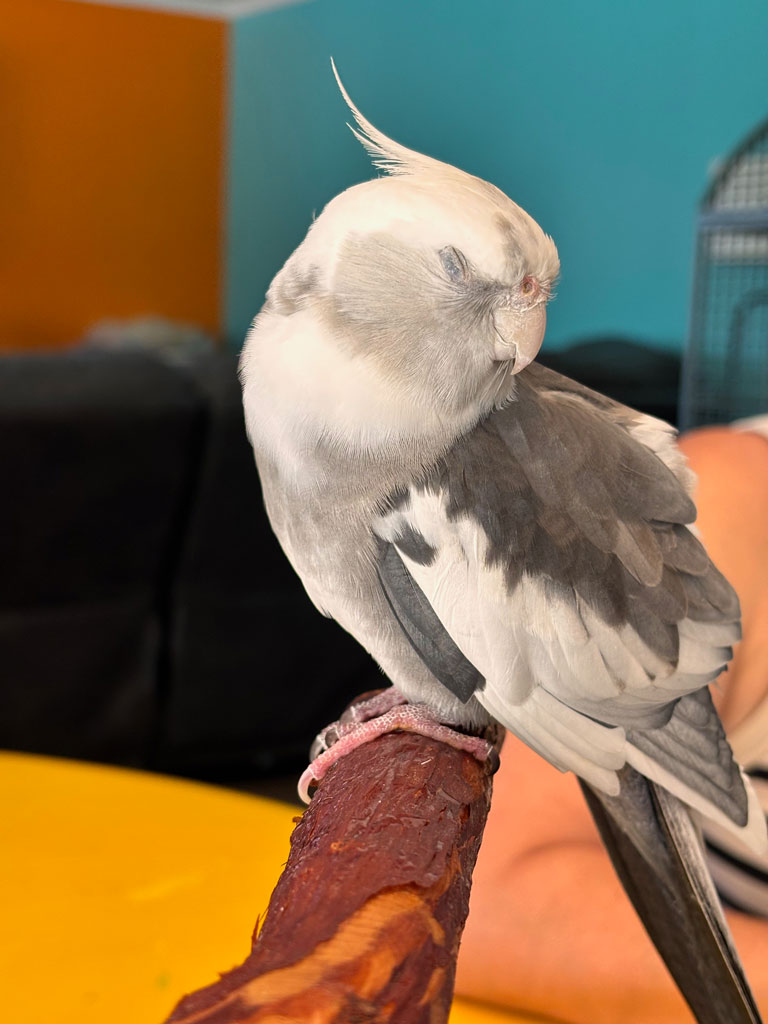
The cute baby chick, who seems to only want to cuddle, turns into a full-time, full-blown, hormone-driven maniac. In the wild, that call of nature is readily and seasonally handled; in your home, your feathered prisoner may lead a constant rebellion against his or her jailers. Think of it this way: Polly Parrot or Cosmo Cockatoo, perched in your living room, is the direct descendant and has the DNA of flying dinosaurs, who survived the great asteroid impact on Earth some 66,000,000 years ago. Jurassic Park isn’t so far-fetched and is indeed still here in your lifetime.
by Leslie Crane Rugg – The Plumery – A Haven for Parrots



Comments